Sunday, October 23, 2011

Egypt: Interviews with SCAF to increase

Yosri Fouda resigned after network censorship
Two days ago the most famous Arab journalist, Yosri Fouda, resigned from his position as prime-time host on the independent ONTV network. After planning to have guests on that would criticize the military council interview on Dream 2 Fouda's boss decided self-censorship was needed to avoid confrontation with the military.

Proof that public opinion matters, even in nondemocratic systems and that the regime is sensitive. The legitimacy of a dictatorship rests in part on popularity.

Popularity is becoming an issue for Egypt's ruling military council whose forces recently killed 25 Christians protesting in the street. "Down with the Field Marshall, down with the military council," was chanted by a few this summer but now thousands agree.

Public opinion used to be easy for Arab dictators to control. States setup channels and broadcast whatever fairy tales suited their needs. Content being controlled by regime men since 1960 when Egypt's state channel transmitted its first broadcast.

Then the tiny State of Qatar financed the politically independent (debatable) satellite-channel Al Jazeera (the island), which launched on November 1st, 1996.

After Al Jazeera's content and reporting provided an alternative to the Western dominated media landscape and became popular for its reporting during the 2003 US invasion of Iraq.

After the military killed the Copts in front of the state-television headquarters Al Jazeera and other independent networks coverage in English and Arabic pushed military popularity way down.

Even the Egyptian military council's patrons in the US and Europe noticed the tragedy of the Copt's protest. 

After ten days the generals concluded damage control was nescessary and two of them appeared on the popular “The 10 P.M. Show” which broadcasts live on the independent Egyptian network, Dream 2.

Putting military officers in front of TV cameras is a trick that the Bush administrations used frequently to make their agenda popular.

In the post-Mubarak context these active-duty military officers are blaming foreign hands, an explanation that resonates in a society manipulated for centuries.

The appearance of military generals will increase as they learn that manipulating public opinion doesn't require the use of state-owned media or overt censorship which only add to the decline in popularity.

If the SCAF can co-opt journalists and private networks the way western governments do in  Washington and Paris, they will have little problem framing their decisions in a way that maximizes popularity.

I hope journalists like Yosri Fouda will find new platforms and networks like ONTV will not become the Fox News of Egypt. State-run Nile News is more than enough.

Sunday, September 11, 2011

The night Giza turned into a 'war zone'


Clashes at Israeli Embassy leave three dead, hundreds injured

BY TROY CARTER, POLITICAL EDITOR

Saturday, September 10th, 2011

Central Security Forces (CSF) fired tear gas and live rounds in hopes of dispersing the hundreds of protesters who had stormed and ransacked the Israeli embassy Friday night.

The unrest at the Israeli embassy began late in the night after a relatively calm day of protests at Tahrir Square and the Ministry of Interior behind the American University in Cairo's downtown campus. Hundreds of protesters later marched to the embassy to take part in tearing down the security wall that Egypt's military erected last week.

Once the wall was torn down, a number of protesters scaled the building, removed the Israeli flag and gained access to a floor which housed embassy documents.

Thousands of official documents were tossed out the embassy balcony; some offered details about the Israeli ambassadors yearly salary. Caravan staff were able to examine several of the documents containing the seal of the State of Israel. Two documents referred to firearms and another was a request for bank cards for the Ambassador. Clearly of little value, protesters still grappled for them as they fluttered down.

Just before the paper rained down, thick white smoke could be seen rising from the roof of the building prompting observers to believe that embassy staff were burning documents in a last minute attempt to protect state secrets.

The attack on the embassy is believed to have been triggered by the recent killing of Egyptian security forces along the Sinai border when Israeli forces purportedly mistook the Egyptians as militants and opened fire. Other protesters expressed anger at the treatment of Palestinians.

Later, tires were lit on fire in the street and two CSF trucks were burned behind the nearby Saudi Embassy, where they had been parked. The use of fire was widespread throughout the night and protesters could hardly finish looting two police stations before they were burned down.

At approximately 11:30 pm, one protester was carried off the front line with a bullet wound to his chest after clashes with the black-clad riot police escalated; he was later confirmed dead. Security forces could be seen using blank ammunition and it is unclear why they temporarily resorted to deadly force.

Choking on tear gas the protesters played a cat-and-mouse game with the government's internal security forces while the Egyptian Army stood on the sidelines after they gained control of both the Israeli and Saudi embassies. At one point the military stationed 16 Armored Personnel Carriers in front of the two embassies; that number decreased later.

When news reached them that the Israeli ambassador had boarded an aircraft and was departing the county a loud cheer went up and protesters momentarily rushed the police. Some in the crowd chanted for an end to military rule.

By dawn, protesters were fighting pitch battles using stones and Molotov cocktails against the CSF who responded by firing flares into the crowds.

Reuters reports that US President Barack Obama urged the Egyptian authorities to defend the embassy but that message was received only after the embassy's offices were breached. Obama is quoted by another wire service as having told Israeli Prime Minister Benjamin Netanyahu that his administration was taking steps "at all levels" to ensure the integrity of the embassy.

Troy Carter is the Political Editor of the Caravan and can be reached at troymcarter@aucegypt.edu. Get his updates live on twitter by following http://www.twitter.com/CarterTroy


--article first published at the Caravan--

Saturday, August 6, 2011

The impossible choice, redux


As we looked at Hosni Mubarak’s face behind the metal bars of his cage the familiar question was asked again, what’s happening in Egypt now?

This week I reunited with a classmate from AUC but in Canada not Cairo. After an eventful year in Egypt I manage to afford the flight back to the US.

I spend a week in my home state of Montana then drive north to Bruno, Saskatchewan, population 750 says the general store’s manager.

As I’m introduced to my new Canadian friends the question comes not infrequently and I’m generally ready for it. What’s happening in Egypt?

The military is in charge now, the Mubarak trial is moving forward but there are a lot of unanswered questions. When are elections, who is eligible, and what parties will be ready?

“And what about old Mubarak? Are they going to kill him?” some ask now that the trial is moving ahead. I offer little but my own distaste for the entire family.

“Are the Muslims going to take control and ruin things?” It’s not that simple, I reply.

My friend’s father, a seemingly well read intellectual listens as I talk about the military’s factories and privileges but he comes back to the Islamists after I tell him about the salafi emergence.

He is pessimistic, they’re going to spoil the country, “I hope there’s not too much democracy right away,” he says.

I get the impression people are more comfortable with letting the military have their money and get away with civil liberties abuses if they keep a lid on the religious extremists, al Qaeda and the sort.

Is that where the west is still at? Are North Americans still falling for the fallacy of false choice, the oldest trick in the Arab dictator handbook? It’s still the radicals or the military regime, eh?

Troy Carter is a former US Senate Defense Fellow who studies political science at The American University in Cairo. He can be contacted at troymcarter@aucegypt.edu or on Twitter @CarterTroy

Thursday, July 28, 2011

Egypt's state media is weighing down the revolution

The plane is racing down the asphalt, its engine straining as the young pilots push the throttle forward, grinning with excitement at the thought of soaring above the dust choked city.

As the end of the runway comes into view and maximum thrust has been reached it's obvious to all that the aircraft is over weight and won't be able to reach the lift threshold. In a split second a decision can be made to save the takeoff by dumping unnecessary cargo.

The Egyptian youth are piloting the revolution and forgot to unload the last regime's baggage. They have a short time to decided what must go and what can stay as this generous crew try to fly away.

The quickest way to lighten the load is to discard the state's printing presses. The giant steel contraptions that mix paper and ink in a not-so-tasty recipe. Today's inflight meal choices are lies topped with misinformation or pro-Mubarak bias, what would you like?

Next out the door has to be state-TV whose broadcasters have never dreamed of flying, this revolution has no sick sacks.

Freedoms are intangible so metaphors come in handy. The point is if we complete the media revolution by abolishing state media or putting it under the public's control, Egypt will fly high. 

Saturday, July 23, 2011

Remember When? Coup in Peru circa 1962

Last night and today it looks like Egypt's Supreme Council of Armed Forces, the Minister of Interior or both are try to discredit political forces namely the 6 of April movement.

I hope I'm wrong but I get the impression that this is just the beginning. Remember when the military in Peru didn't care for their democratically elected president?

July 19, 1962 - New York Times
Here's the headline.

Now I'm writing this from a bar in Amsterdam so I don't have time to find a history buff to help with the compare and contrast. But I don't need that to make a point.

To Field Marshall Tantawi, General Sami Anan, etc. -After General's Godoy and Lindley headed up this military coup against a democratically elected president (Prado) they were surprised by the widespread condemnation from the international community.

The United States in particular was pissed off by what happened in Peru in part because Prado had declared war on the Axis powers.

To the Egyptian public - the military is to be thanked for not shooting us on January 28th and after because they could have. But don't forget that the military's job is protecting the nation from external threats. Furthermore, don't let the Minister of Interior, the institution you hate, come back like they didn't just kill 800+ people.

We have to live our lives in the present, drawing what we can from the past. Don't let Egypt 2012 be like Peru '62.

Monday, July 18, 2011

Important Questions Egypt Must Answer

Left out of list making? Me too, so I came up with a list of the most pressing questions Egypt must answer. If you think others need to be added or you know the answers put them in the comments.
  1. When will parliamentary elections be held?
  2. Current electoral law says that half of parliament will be locally elected candidates and the other half from party lists. Additionally, the minimum vote threshold is 2% for parties to gain seats in the People's Assembly. Will this create an overly fragmented institution?
  3. Will the National Democratic Party be allowed to participate, will its members be blacklisted?
  4. How long will parliament have to create the new constitution?
  5. If the new constitution is not approved of by the military, will they dictate amendments?
  6. Will the new constitution provide real and powerful checks and balances on branches of government?
  7. How long will the public have to debate the new constitution before a referendum is held?
  8. How many people will vote and will Egyptians abroad be allowed to vote?
  9. Will the state's media provide fair and balanced coverage of opinions, parties, and candidates?
  10. Will the military grant itself amnesty before a civilian government takes control of the state?
  11. Will judges be present at every polling station?
  12. Will vote buying and voter intimidation be prevented?
  13. Will Egypt host international election observers? If not, will this jeopardize legitimacy?

Saturday, July 16, 2011

The Praetorian Problem

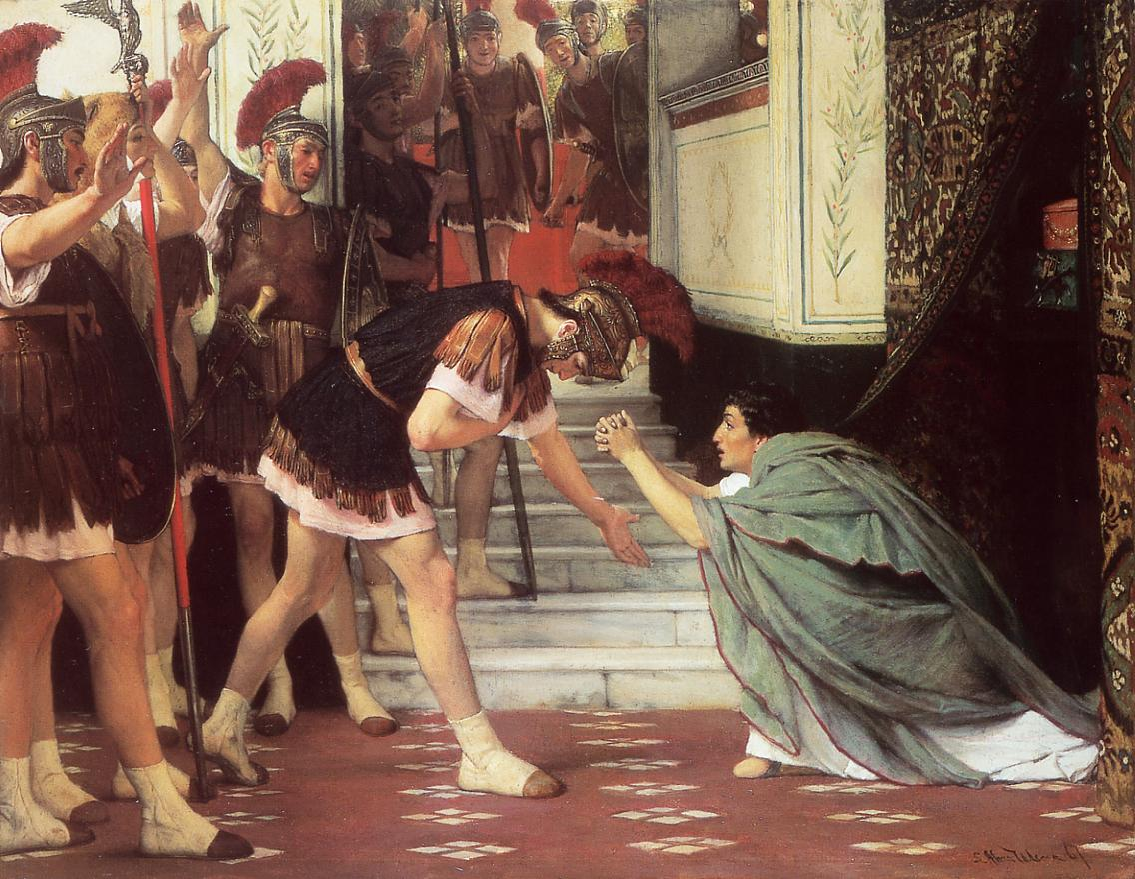
Proclaiming Claudius Emperor, by Lawrence Alma-Tadema. Members of the Praetorian Guard found Claudius hiding behind a curtain in the aftermath of the murder of Caligula and proclaimed him emperor.

Because the democratic activists who scheduled the January 25th protests did not expect that it would lead to the ousting of Mubarak, they did not feel the need to draft reform plans, these were not revolutionaries, mores simply idealists. Since the mass uprising the reform movement has been running blindly into the transitional period and is at least partially responsible for the confrontation with the now ruling military council, the Praetorian guards.

There are two problems in common for states in democratic transitions. The first is deciding what to do with the old regime characters. How will Egypt extract justice from the Mubarak family, Omar Suleiman, Habib al-Adly, Ahmed Ezz,, etc. who clearly carried out or supported violating human rights and denied the Egyptian people the basic rule of law?

Secondly, many countries in a transition including Egypt are faced with the task of reducing the military’s role in politics and government. The establishment of a new relationship between an elected civilian government and a corps of professional military officers is historically the harder of the two issues. Here to Turkey’s past is relevant, for over 80 years populist democracy has been suppressed by the military complex known as ‘deep state.’

By studying states that change from autocracy to democracy its become clearer that not all attempts at democratization succeed. Last week Cairo hosted visiting scholars from the Arab Turkish Conference of Social Sciences who spoke about Egypt’s future. The consensus among these analysts is that Turkey is no model because it is still in transition, its’ press is not free, its citizens unequal, the state is still pervasive involved in individual’s lives. Egypt needs to stop oversimplifying Turkey’s complex and sometime awful political history as a desirable model simply because its a successful state today.

Right now it seems that the Supreme Council of the Armed Forces is hoping that Egypt will try to forgive and forget the old regime. But the protesters in Tahrir Square are showing they won’t which decreases SCAF’s legitimacy everyday. We can only guess why the iconic figures of the Mubarak regime haven’t been prosecuted and punished let alone the hundreds of officers complicit in the killings that took place during the uprising. While the SCAF might not be willing to prosecute Mubarak and company, it doesn’t mean that a future government or a future president can‘t or won‘t. However if the prosecution doesn’t take place soon it might never as was the case in many other democratizing countries like Chile in the early 90’s.

The Nasserites, who have erected a tacky shrine in Tahrir to worship the first dictator, won‘t let us forget that the military rules politics. President Nasser created the authoritarian system that Egypt has enjoyed since the late 1950’s. To prosecute Mubarak for sitting in Nasser’s throne might be too much for the Nasserites and for the SCAF as it seems there might be honor among thieves in Egypt. Both the Nasserites and the anti-Tahrir demonstrations at Roxy Square give little hope that Egypt has matured into a society that values the rule of law over the rule of men.

If Egypt’s military tries to grant amnesty for the ex-regime, like in Turkey when generals guaranteed their own immunity from prosecution before they allowed a civilian government to be elected in 1983, it could lead to a disastrous confrontation leading back to authoritarianism. And this sort of action has precedence, the Guatemala military announced its own amnesty just 4 days before President Cerezo took office in 1986 as did the Chilean military when Pinochet when he left office.

The prosecution of Mubarak and the regime is also closely connected with the second major issue, forging a new relationship between civilian government and the military/security institution.

Egypt’s SCAF has an idea about what that sort of relationship should be. On May 26th, it was reported that Major-General Mamdouh Shain, the Defense Minister's legal-adviser, told a conference that the military needed to have a special status so that it would be exempt from the president's "discretion" and that the military budget and operations should remain secret from parliament.

Last Tuesday I watched as an officer jumped out of a tan Jeep with soldiers in the back, quickly stepping in front of a motorcycle, unholstering his pistol and placed it against the temple of the driver for a very minor traffic violation. You'd think this was a pre-Jan 25th incident, but it took place Tuesday and is just one example of the continued arrogance of Egypt's security forces who have the complicit backing of the military. Furthermore the SCAF continues to use military courts to convict protesters of violating emergency law, the end of which is not low on the list of protester’s demands.

If Egypt is to be a new democracy the greatest challenge will be in curbing the political power of the military establishment and transforming the Praetorian guard into a professional institution committed to protecting the nation, not itself, from exterior threats. Activists keeping this in mind will see a much shorter period of transition. And if Egypt’s military wishes to maintain many of the powers and privileges it enjoys it will do well to prosecute the old regime immediately while it still controls the situation.