Showing posts with label Cairo. Show all posts

Sunday, September 11, 2011

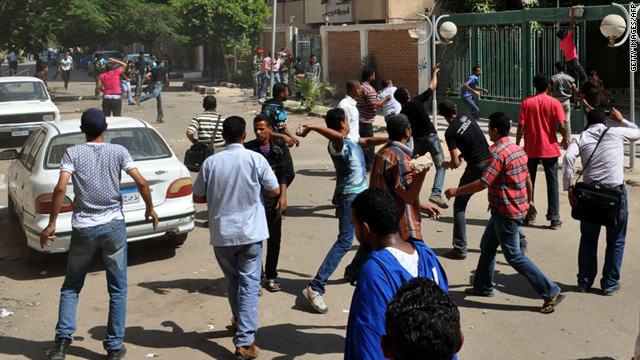
The night Giza turned into a 'war zone'


Clashes at Israeli Embassy leave three dead, hundreds injured

BY TROY CARTER, POLITICAL EDITOR

Saturday, September 10th, 2011

Central Security Forces (CSF) fired tear gas and live rounds in hopes of dispersing the hundreds of protesters who had stormed and ransacked the Israeli embassy Friday night.

The unrest at the Israeli embassy began late in the night after a relatively calm day of protests at Tahrir Square and the Ministry of Interior behind the American University in Cairo's downtown campus. Hundreds of protesters later marched to the embassy to take part in tearing down the security wall that Egypt's military erected last week.

Once the wall was torn down, a number of protesters scaled the building, removed the Israeli flag and gained access to a floor which housed embassy documents.

Thousands of official documents were tossed out the embassy balcony; some offered details about the Israeli ambassadors yearly salary. Caravan staff were able to examine several of the documents containing the seal of the State of Israel. Two documents referred to firearms and another was a request for bank cards for the Ambassador. Clearly of little value, protesters still grappled for them as they fluttered down.

Just before the paper rained down, thick white smoke could be seen rising from the roof of the building prompting observers to believe that embassy staff were burning documents in a last minute attempt to protect state secrets.

The attack on the embassy is believed to have been triggered by the recent killing of Egyptian security forces along the Sinai border when Israeli forces purportedly mistook the Egyptians as militants and opened fire. Other protesters expressed anger at the treatment of Palestinians.

Later, tires were lit on fire in the street and two CSF trucks were burned behind the nearby Saudi Embassy, where they had been parked. The use of fire was widespread throughout the night and protesters could hardly finish looting two police stations before they were burned down.

At approximately 11:30 pm, one protester was carried off the front line with a bullet wound to his chest after clashes with the black-clad riot police escalated; he was later confirmed dead. Security forces could be seen using blank ammunition and it is unclear why they temporarily resorted to deadly force.

Choking on tear gas the protesters played a cat-and-mouse game with the government's internal security forces while the Egyptian Army stood on the sidelines after they gained control of both the Israeli and Saudi embassies. At one point the military stationed 16 Armored Personnel Carriers in front of the two embassies; that number decreased later.

When news reached them that the Israeli ambassador had boarded an aircraft and was departing the county a loud cheer went up and protesters momentarily rushed the police. Some in the crowd chanted for an end to military rule.

By dawn, protesters were fighting pitch battles using stones and Molotov cocktails against the CSF who responded by firing flares into the crowds.

Reuters reports that US President Barack Obama urged the Egyptian authorities to defend the embassy but that message was received only after the embassy's offices were breached. Obama is quoted by another wire service as having told Israeli Prime Minister Benjamin Netanyahu that his administration was taking steps "at all levels" to ensure the integrity of the embassy.

Troy Carter is the Political Editor of the Caravan and can be reached at troymcarter@aucegypt.edu. Get his updates live on twitter by following http://www.twitter.com/CarterTroy


--article first published at the Caravan--

Saturday, July 9, 2011

Police Officer Assassinated in Cairo

According to sources a police officer who had murdered several people in the city of Suez during the January 25th revolution was shot and killed today with a handgun.

After 14 Suez officers were acquitted of murder charges last week thousands of people began to execute civil disobedience plans with protests and labor strikes. The bereaved father of one young boy who was killed by an officer called in to Egypt's most popular talk show and promised that he would kill the policemen himself since the state was failing to convict them of any crimes.

At this point we have no indication that it was in fact an assassination carried out by a party from Suez but clearly the intent and motive to do so is present.

Several revolutionary youth have expressed the need to start killing members of the old regime since the state was failing to meet their demands. And others are predicting that this is the beginning of a string of assassinations that will likely include government ministers and security forces.
Attacking the police headquarters in Suez on July 7th - by Getty Images
 At this time all political groups are disavowing violence and continue using non-violent tactics like sit-ins, it is unquestionably true that many citizens feel that the regime has not fallen and is now being propped up by the military's Supreme Council of Armed Forces who took control of the state on February 11th.

On Friday political groups calling for a mass rally attracted hundreds of thousands of Egyptians to take to the streets and squares in numerous cities. The protesters demands were for the speedy trials of those responsible for killing protesters, the dismissal of the State's Attorney and the Minister of Interior for incompetence, and the end of military tribunals which have been used to sentence thousands of civilian protesters to years in jail with a complete disregard for existing judicial norms and civilian courts.

Among the numerous groups participating Friday was the Muslim Brotherhood who decided that they would go to the rally but did not condone the sit-in that is still taking place. At the time of this writing there are approximately 15,000 people still sitting in Tahrir Square.

If Egypt's SCAF does not move quickly it is likely we will see an immediate increase in the amount of political violence as well as a massive decrease in the military's legitimacy. Legitimacy it depends on to enforce the timetable that it has largely dictated and to protect its economic interests.

Egypt's military industrial complex accounts for 15-20% of the entire Egyptian economy and the chairman of the SCAF is also the Minister of Military Production, Field Marshall Tantawi.

While the military's budget is a state secret, respected analysts believe that it is about $5 billion, of which $1.3 billion comes directly from the United States.

Earlier this year the military's legal representative was quoted in newspapers as seeking an extra-constitutional status for the military so that no civilian governor could attempt to control its business or military operations.

The current Prime Minister, Essam Sharaf, is set to speak shortly but no one is expecting anything substantive to be announced. Many observers including myself believe that Sharaf's best decision would be to resign immediately if he wants to keep any of the popular support that was shown for him when the SCAF announced his filling the position in March.

Monday, June 6, 2011

New Polling Data - Egypt

by: Troy Carter

Cairo is Egypt's mega-city, population 20 million
Cairo: USAID has funded a public opinion poll in Egypt that shows democracy a bit lower on the priority list than some expected. The poll had a legitimate sampling size and method, it will allow analysts to set benchmarks and help the liberal politicians that the US government supports to build a populist agenda. Interestingly it seems that Saudi Arabia, the US's ally, seems to be working against the US efforts by allegedly supporting conservative Islamist groups in the country.

Confirming what many hoped- 94% of Egyptians feel that Mubarak leaving power was good for the country. It's significant to see that confirmed by data because it reveals how unrepresentative the pro-Mubarak demonstrations are.

The results also show that an air of optimism is lingering with 89% of the population feeling positive about the future despite the fact that 41% of Egyptians are struggling for survival. What makes them optimistic? When they see Al Jazeera reporting high-profile regime members has been put in prison and are being tried by the beloved justice system.

Have that with a grain of salt- Egyptians moods will turn sour quickly if the unemployment problem isn't changed soon, it is listed as the top priority for the future government. Speaking of future governments the survey will simultaneously worry and relieve politicians.


Only 2% of the sample said they were ready to vote for the islamist Muslim Brotherhood. But liberals have no reason to celebrate as a whopping 65% said they were unsure who they would support and a number of  nationalist parties are ready to steal liberal votes. Combine the electorates dismal education and the high level of religiosity in Egypt makes the parliamentary elections a toss up. My gut is telling me that we're going to see the Muslim Brotherhood get just under half the parliament and a mixed-bag liberal front fall in with 30%

Last week New York Times columnist Thomas Friedman advocated for President Obama to push Egypt's Supreme Council of Armed Forces to postpone elections. It appears that despite the attention the public isn't hearing it (Friedman isn't on Al Jazeera), only 21% think that September is too early for elections and a decent number think that elections should be held sooner.

That's no news for the Muslim Brotherhood and bad news for liberals. Now that they've got the date set the SCAF and the Muslim Brotherhood will both be working hard to get the right people into power. If liberals are able to build a coalition they might have a shot at balancing the spectrum. I'm not afraid of a MB government, just skeptical that they'd accomplish anything, but the first parliament will be so important in setting the constitution and the presidential elections.
Arab proverb "Break my heart but don't come near my bread." 
Egypt: world's largest wheat importer
My hope for Egypt lies with the low-income working class, a group so large and so potentially politicized. They've fought and won jobs only to get paid dismal salaries. 23% of folks in Egypt say wages are among the top three priorities after unemployment and security. However the state has clamped down on labor action and workers seem to be having trouble forming real unions. This is compounded by the SCAF's recent increase in state subsidies as they try to keep the population from conducting a real revolution.

The liberal electoral agenda will need to begin with jobs and security messages that highlight the Muslim Brotherhood/Salafists inability to develop even a simple plan for the future. I expect we'll see liberal and leftist campaigns hammer the Muslim Brotherhood for betraying the revolution just when it got started but will stay away from criticizing the SCAF. And why go out on a limb when citizen journalists are writing furiously about the military's post-Mubarak actions. The Muslim Brotherhood agenda will likely focus on socio-religious issues with nationalist undertones since its hard to distill economic plans from the Quran.


Naguib Sawiris
The survey challenged the mainstream media narrative that Twitter and/or Facebook were key to the uprising. Only 6% of Egyptians said they got news from social media and most don't have access to the internet. Adding to injury it seems only 28% of people participated in the revolution, I had calculated a much smaller number. Last Laugh - An Egyptian friend of mine told me "voters are just waiting to see if (billionaire) Naguib Sawiris is going to buy their votes."

Sunday, May 15, 2011

Wednesday, May 11, 2011

Sectarian Violence in Egypt: A conversation with John Ehab

Many Christians in Egypt tattoo their hands with crosses
What a stroke of luck to have met John Ehab in a graduate class on foreign policy. As classmates we explored the relationship between news media and foreign policy but now as friends John helps me decipher the nuances of Egyptian politics. Himself a Copt, John is particularly able to speak about the Egypt's Muslim Christian schism.

We conducted this interview several weeks ago and hadn't planned on publishing it for awhile but the recent violence in Imbaba has increased interest in this recurrent problem.

Our goal was to shed light on the politics of a highly religious society, primarily for an international audience especially the discussion of the "impossible alternative" tactic used by Mubarak.

This is the first 8 minutes of a twenty-five minute interview with the remaining segments to be posted in the coming days.


Monday, May 9, 2011

Egypt Falling Asleep Again?

In Cairo, Kamelia Shehata was on TV Saturday night to let the world know that she did not convert to Islam as was the rumor around Egypt. She's even managed to stay married to her loving husband who is a Coptic priest.

I say did not in the first sentence because she might soon given how rationale fundamentalist Muslims are behaving.

The actual rumor was that Shehata left her husband and converted to Islam but was then kidnapped by agents of the Coptic Church who were relentlessly moisturizing the zabiba that may or may not have formed. For a few months this story has been fueling protests by Muslim groups who were calling for her release.

"I was born Coptic and will die Coptic. I was never held by the church at any time." Shehata told Al-Hayat TV. The actual reason she "disappeared" was because she and her family were worried that the same Muslim groups would come kidnap her.

Probably a reasonable action given that someone altered a photo of her wearing a head scarf. Which seems to be a trend now, recently we had the fake photo of Osama bin Laden, and before that Ahram photo of Mubarak striding in front of Obama.

A fake photo of Kamelia Shehata wearing an Islamic head scarf
Her attorney Naguib Gobrael is an unprofessional idiot so I'm not surprised she decide to appear on TV instead of going to a court to clear up the whole ordeal. Gobrael childishly chastised his client in an interview with Daily News Egypt.
"I know she is under severe psychological pressure, but I cannot move on with her case if she is taking decisions without consulting with me.”
Full stop

Were we dreaming? Did Egypt not collectively revolt against its corrupt regime? If we were and this is the Egypt I really live in put me back to sleep because that was a great dream.

Metaphor overload- Egypt is either falling back asleep or never woke up. This kind of action is counter-productive. If the people go back into that state of muted discontent, political apathy and strange obsession with personal status we can expect New Egypt to be no different than old Egypt.

So what is there to bring us back to that Egypt we fought for on Jan. 28th?

We can start by prosecuting Hosni, Habib, and the rest of the gang that acted outside the law for so long. If it takes a street action to make that happen then Yella. The trial needs to happen soon not only for Egypt but to boost the freedom movements in Libya, Syria, Yemen, Bahrain, Saudi, Tunisia the list goes on. Lets show them the light at the end of the tunnel.

All roads lead to Rome? For Salafists yes, not only are Muslim fundamentalists annoying a harmless Coptic family in Minya but they've decided to purge Imbaba [a district of Cairo] of all the Churchs by burning them down. The sectarian fighting has led to at least 10 deaths in the last few days.

Photo by Samy Waheeb

If you're not a crazy person your roads can lead back to a Rome that isn't burning. Lets bring the countries attention back to things that are far more important like ending the kangaroo court the military is using against civilians. Talk about how the state is still allowing military generals to collect rents from North Coast properties they were gifted by Mubarak. Or talk about something simple like ending the export of gas to Israel at below-market prices or that Emergency Law is still in place.

Anything but this kind of religious hate that divides what were so recently a unified people.

Friday, May 6, 2011

Imbaba Boys

by Troy Carter

Residents of Imbaba fight Mubarak's security  forces in Cairo -Jan. 30th


The media has focused mainly on Tahrir Square and the kids who tweeted the Egyptian uprising. To add to your understanding of what happened in Egypt here's a minute long look at some guys from one of the poorest districts in Cairo facing down armed police. None of them were tweeting, all of them were fighting.


They not only successfully defended the streets of their neighborhoods but thousands of them marched to Tahrir Square to shore up the downtown lines. We recognize the grunts who fought and died in the really tough days and for that we salute the boys from Imbaba.

Author's note: Thousands of women resisted and continue to resist the corrupt regime in Egypt but in the days that I spent in Imbaba I didn't find women in the street.

Tuesday, March 29, 2011

Reforming Egypt's Media [video]

The republican state depends on an independent and active press to keep those functionaries of government acting on our behalf and in our interests accountable to the principles that we lay down as their mandate. The press is the vanguard of liberated people, uncensored journalism a bulwark against the worst in ourselves. Without it we are vulnerable.

Egypt's revolutionary moment could slip by without having affected much if journalists aren't allowed unfettered access to view and record the proceedings of the regime. The military in particular needs to be meticulously monitored during this transitional period. To understand more about what young Egyptians want we took to the streets of Cairo to speak with them.

Friday, March 18, 2011

The science behind the supermoon and the tsunami


By Troy Carter/Daily News Egypt

CAIRO: On Saturday evening, the moon will be 356,577km away from Earth, the closest it’s been in 18.6 years – a phenomenon called supermoon that results in a 14 percent increase in the moon’s appearance.

Some astrologers argue for a connection between the supermoon and natural disasters. Astronomers and physicists dismiss astrology as pseudo-science. But with the occurrence of a 8.9-earthquake in Japan that triggered a tsunami and numerous aftershocks just last week, the old debate is reignited.

The American University in Cairo will host a supermoon lecture on Saturday at 6 pm, followed by a telescopic observation at the downtown campus. It will be in Arabic and open to public.

Dr. Alaa Ibrahim, an award winning Astrophysicist and current professor of space astrophysics and physics at AUC, told Daily News Egypt that supermoon doesn’t cause earthquakes or other natural disasters on Earth. The moon, however, exercises a gravitation pull on the ocean tides. Lunar gravity also changes the Earth’s atmospheric pressure.

Yet, "the assertion that the moon’s position caused the catastrophe in Japan is not warranted and needs to be critically examined. There are scientists investigating the relationship as we speak and it’s too early to make any claims,” he explained.

The moon exercises a minor gravitational pull on the molten lava beneath the earth's crust but it does not have the energy to cause volcanic eruptions, Ibrahim said.

Earthquakes, he added, occur when stress overwhelms the massive plates that form the earth’s crust, their realignment causes the quakes. If the earth has already built a high level on internal stress an event like a supermoon may only act as a trigger, but a full scientific investigation is needed.

Saturday’s lecture will be in Arabic and open to public. On Sunday the same lecture will be given in English at 1:30 pm followed by a 7:30 pm observation at AUC’s New Cairo campus.
--
Daily News Egypt Link 

Monday, March 14, 2011

Obama and the Arab Revolts

Since the Tunisian uprising began the Obama administration's response has been characterized in a variety of ways including muted, hypocritical, and even fair. As the dust settles more thoughtful opinions are being formed. Was the administrations response due to an unprepared and outdated foreign policy team? Was it a calculated silence? Weigh the evidence (or not), and let us know what you think.


Wednesday, March 9, 2011

Army Breaks Camp in Tahrir

Traffic passes protesters in Tahrir Square on March 7th
Cairo - Unidentified men assaulted several hundred protesters camped in Tahrir Square on Wednesday. Using knives and stones the attackers tried to disperse the pro-democracy forces occupying Egypt's famous square. After a period of tense conflict the Egyptian Army sent troops in to tear down tents and arrest protesters still in the square's center.


Numerous activists involved sent out distressed messages on Twitter, making it clear that the military has decided to end the weeks long sit-in. The protesters demands are not uniform, some want more transparency in the interim government and others, the end of the 30 year-old Emergency Law.


This latest crisis comes during a week of heightened violence. On Tuesday, at least 13 people died and 140 injured in the Muqattam neighborhood. Some are reporting the violence as sectarian but others are convinced the former regime's security apparatus is instigating it.


Officers have also announced a 9PM curfew in Tahrir Square, broadcasting it over loudspeakers. For weeks the curfew has been 12AM and only sporadically enforced.

The actions of the Army seem at odds with their recent decision to sack Ahmed Shafik from the prime minister's office. Shafik was seen as a survivor of the Mubarak regime and intensly hated by the protesters.

In addition, the Army allowed reformers to raid the offices of the Amn Dawla (State Security's Intelligence Bureau). At this point it's unclear as to why the military has changed policy in Tahrir Square.

Egypt's Supreme Military Council has ruled the country since February 11th, the day when the former President, Hosni Mubarak, was forced out of power by mass demonstrations.


Wednesday, February 23, 2011

Military: Constitutional Reforms Displayed Later Today

Mohammed ElBaradei called for a new constitution in Egypt
The Supreme Military Council of Egypt's member, General Abdel-Moniem Cato, announced that the constitutional reforms will be available today.

Instead of scrapping the undemocratic constitution crafted by Egypt's dictators to ascertain their power the military chose a small committee to draft amendments.

Many activists and intellectuals have called for a new constitution instead of a reform process including Mohammed ElBaradei and Alaa al Aswany. 

This move reinforces earlier analysis that the Egyptian regime once headed by Hosni Mubarak is still actively working to take Egypt back to the structure that gave it complete access to the nation's power and wealth.


Thursday, February 17, 2011

Egypt: Why Fear Chaos? Fear the Regime.

But don't you think chaos will ensue?

It's a common countering question to the request that the military regime give up political power and let civilians govern during the transition. It became even more prevalent when the military broadcast a mass text message to Egyptian mobile phones on Feb. 18th saying essentially that.

The argument goes that by allowing civilians to run transitional Egypt the military would have no reason to serve. They would quit protecting the streets by simply going home or back to their barracks. Criminals would then begin stealing everything they could carry.

That may happen but its unlikely since unemployment is an enormous problem in Egypt and the Army is a good job for many, especially for career officers who are well paid.

The new face of Egypt's military regime is General Tantawi
Remember that Egypt has been ruled by an autocratic military regime since 1952 and the call of the Jan. 25 protesters was the downfall of that system. By deposing Mubarak, a palace revolution, the regime has distracted many Egyptians from their core demand.

Instead of letting the civilian protesters build a democratic future, the regime is using symbolic investigations into some scapegoats that will lead to kangaroo courts. Smoke and mirrors that are allowing for the military to consolidate power.

Why couldn't the military announce that it would protect the people from criminals while a coalition of civilians who aren't connected to the regime carry out transitional government functions. Undoubtedly, the patriotism of  everyone below mid-grade officer would ensure the protection of  the people during such a vulnerable period.

Instead the regime is still dictating. It dictated a constitutional committee, dictated a timetable for elections, and is already cracking down on political freedoms hard won during the protests.

By all accounts the timetable the military dictated for elections is too short for the new political society to organize. This favors the regime who already has a party system and platform in place

Why? Top officers might be implicated in corruption, a chance the regime isn't willing to take. Why hasn't the Egyptian prosecutor started a corruption investigation into the Mubarak family?

Don't fear chaos, fear the regime.

Saturday, February 12, 2011

The Egyptian Revolution Day 4


Jan. 28th, a burning police truck near Tahrir Square
Friday, Jan. 28th Cairo: It was just after 9PM on the Friday of Rage, pretty dark but with some street lamps 
giving us away. Thousands of protesters were fighting with sticks and stones to protect themselves from the waves of Mubarak's riot police. Central security forces kept pushing into Tahrir Square from Qasr el Einy street. This was the epicenter of the Egyptian revolution. The regime had a 20 man front with an armored truck and another 20 in reserve where it crosses Sheikh Rihan Street.

We had pushed them back a few times using the corner of the Mugamma (a government building) as a terrain feature to hide behind. Little by little we began inching forward, pushing pieces of tin sheeting and office furniture in front of us as a shield from these four soldiers who were really giving it to us with shotguns, the 12 guage 5-shot pump action type that you see on TV. About half a dozen young men were smashing sidewalk tiles and the curb into fist sized stones and skipping them up to the front from a safe spot where they'd be hurled at the police.

The ground was all wet because we were trying to make puddles that would soak up some of the tear gas. It was that kind of swirling murky mess of water you get in front of a door when it rains, with everybody tracking mud through it. We had to kneel down to hide and it was soaking up into our clothes.

Two of the central security guys started to walk down the street towards the square, shooting bird-shot at these two protesters who kept harassing them from around the corner on Mohamed Mahmoud Street. From our spot we could see these cops weren't getting followed by others. I remember wondering why they didn't stagger their shooting. It was a bad choice because they both started reloading at the same time. Three boys hopped the fence and gave them some good shots with stones from about 20 feet, the width of the street.

They dove back over achest high railing that separates the street from the sidewalk. Some other police saw the trick and shot towards us. I bear crawled back up to the front and came right up behind this older guy who was one of the shield men. These guys were in charge of making sure the desks and sheet metal kept upright and moving forward so others could throw stones at the police. Every once in awhile I got the impression that someone was confused about why I was there but once they saw my camera they understood. I kept wondering how this was going to end.

About five minutes later the protesters were giving it to them pretty good, we'd moved up to the backside of the building and the perimeter fence was blocking us from moving the barriers any further. The shields had pushed up past a new fire hydrant I'd seen working a few days earlier, it was right in front of a fire station with one of the ladder trucks parked half way out the garage. Somebody went up and opened that hydrant to help with the gas. They weren't using it on us at the moment because they were too close and only one in ten of the security forces had a mask. But it was always a good idea to flood the street when you could. Any little thing the protesters could do became an act of resistance.

Jan.28 9:27 PM In front of the American University in Cairo
Central security was getting scared, you could see it in their body language. They retreated down Qasr el Einy and some went down Sheikh Rihan Street. Of course we chased them as we had been doing all day. Then a pause, We had a minute of relative calm and I took a few photos.

Then police came out and fired down on us from the top of AUC's Ewart Hall. I remember thinking how ironic it was that I was getting shot by someone in my university. The move was a good one and we got scattered. We re-formed the line and pushed up again.

Our lines were getting really close to theirs and a fire had started in the ladder truck, I guess somebody lit it on purpose. A street lamp right above the whole thing got smashed which helped us more than them because they were formed up tighter than our side. If you put a stone in the area you would hit one but they had to aim at us.

I got hit with a rubber bullet below my right eye then. So much blood came out I thought it had been a real bullet. Some of the officers still had their pistols and we were hearing news that people all over the city were getting killed while doing the same thing we were. 
A fire truck burns amid the protest in Cairo

I got my breath back and re-examined my whole situation while running to the back and flopping down in the yard in front of the Mugamma. I got some cheap tissue taped on and went to look for stones.


Two hours later central security packed their bags and went into hiding. The Army came into the square with tanks and APC's. The Egyptian revolution was off to a great start.