 |
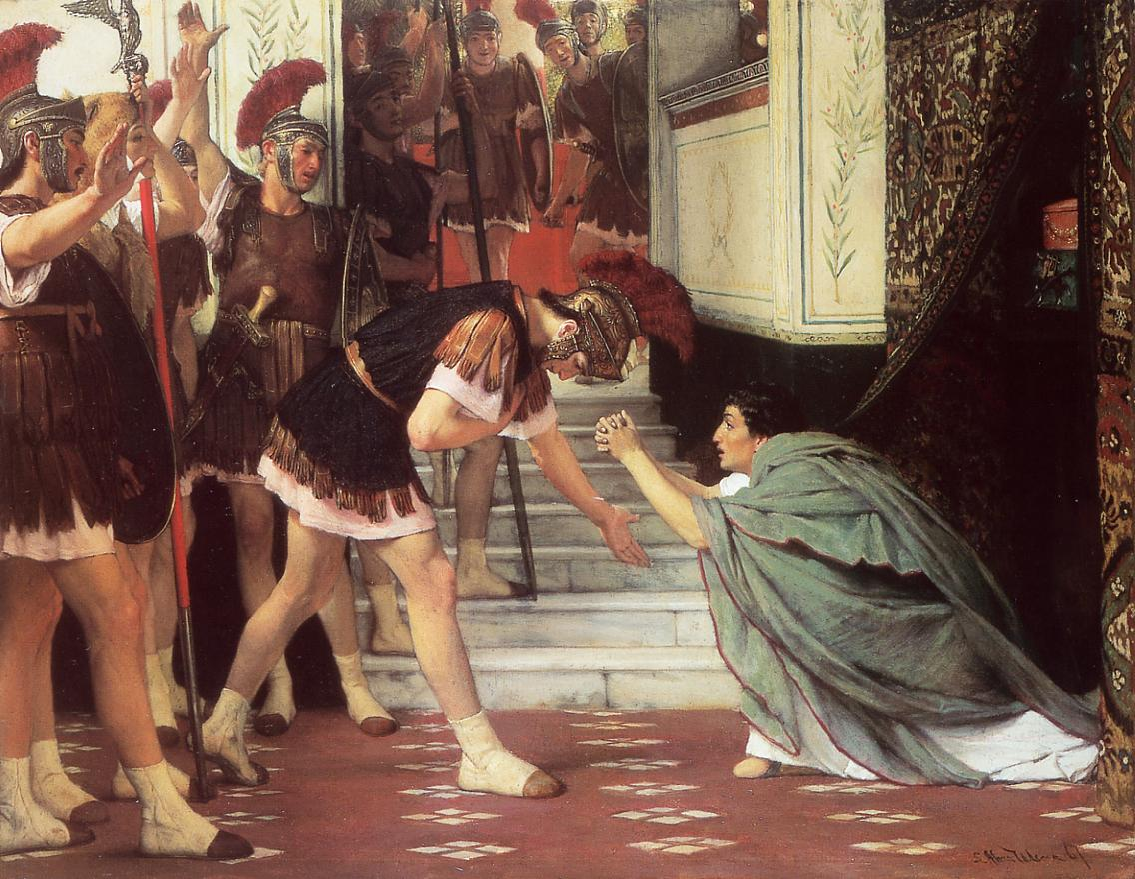
Proclaiming Claudius Emperor, by Lawrence Alma-Tadema. Members of the Praetorian Guard found Claudius hiding behind a curtain in the aftermath of the murder of Caligula and proclaimed him emperor. |
Because the democratic activists who scheduled the January 25th protests did not expect that it would lead to the ousting of Mubarak, they did not feel the need to draft reform plans, these were not revolutionaries, mores simply idealists. Since the mass uprising the reform movement has been running blindly into the transitional period and is at least partially responsible for the confrontation with the now ruling military council, the Praetorian guards.
There are two problems in common for states in democratic transitions. The first is deciding what to do with the old regime characters. How will Egypt extract justice from the Mubarak family, Omar Suleiman, Habib al-Adly, Ahmed Ezz,, etc. who clearly carried out or supported violating human rights and denied the Egyptian people the basic rule of law?
Secondly, many countries in a transition including Egypt are faced with the task of reducing the military’s role in politics and government. The establishment of a new relationship between an elected civilian government and a corps of professional military officers is historically the harder of the two issues. Here to Turkey’s past is relevant, for over 80 years populist democracy has been suppressed by the military complex known as ‘deep state.’
By studying states that change from autocracy to democracy its become clearer that not all attempts at democratization succeed. Last week Cairo hosted visiting scholars from the Arab Turkish Conference of Social Sciences who spoke about Egypt’s future. The consensus among these analysts is that Turkey is no model because it is still in transition, its’ press is not free, its citizens unequal, the state is still pervasive involved in individual’s lives. Egypt needs to stop oversimplifying Turkey’s complex and sometime awful political history as a desirable model simply because its a successful state today.
Right now it seems that the Supreme Council of the Armed Forces is hoping that Egypt will try to forgive and forget the old regime. But the protesters in Tahrir Square are showing they won’t which decreases SCAF’s legitimacy everyday. We can only guess why the iconic figures of the Mubarak regime haven’t been prosecuted and punished let alone the hundreds of officers complicit in the killings that took place during the uprising. While the SCAF might not be willing to prosecute Mubarak and company, it doesn’t mean that a future government or a future president can‘t or won‘t. However if the prosecution doesn’t take place soon it might never as was the case in many other democratizing countries like Chile in the early 90’s.
The Nasserites, who have erected a tacky shrine in Tahrir to worship the first dictator, won‘t let us forget that the military rules politics. President Nasser created the authoritarian system that Egypt has enjoyed since the late 1950’s. To prosecute Mubarak for sitting in Nasser’s throne might be too much for the Nasserites and for the SCAF as it seems there might be honor among thieves in Egypt. Both the Nasserites and the anti-Tahrir demonstrations at Roxy Square give little hope that Egypt has matured into a society that values the rule of law over the rule of men.
If Egypt’s military tries to grant amnesty for the ex-regime, like in Turkey when generals guaranteed their own immunity from prosecution before they allowed a civilian government to be elected in 1983, it could lead to a disastrous confrontation leading back to authoritarianism. And this sort of action has precedence, the Guatemala military announced its own amnesty just 4 days before President Cerezo took office in 1986 as did the Chilean military when Pinochet when he left office.
The prosecution of Mubarak and the regime is also closely connected with the second major issue, forging a new relationship between civilian government and the military/security institution.
Egypt’s SCAF has an idea about what that sort of relationship should be. On May 26th, it was reported that Major-General Mamdouh Shain, the Defense Minister's legal-adviser, told a conference that the military needed to have a special status so that it would be exempt from the president's "discretion" and that the military budget and operations should remain secret from parliament.
Last Tuesday I watched as an officer jumped out of a tan Jeep with soldiers in the back, quickly stepping in front of a motorcycle, unholstering his pistol and placed it against the temple of the driver for a very minor traffic violation. You'd think this was a pre-Jan 25th incident, but it took place Tuesday and is just one example of the continued arrogance of Egypt's security forces who have the complicit backing of the military. Furthermore the SCAF continues to use military courts to convict protesters of violating emergency law, the end of which is not low on the list of protester’s demands.
If Egypt is to be a new democracy the greatest challenge will be in curbing the political power of the military establishment and transforming the Praetorian guard into a professional institution committed to protecting the nation, not itself, from exterior threats. Activists keeping this in mind will see a much shorter period of transition. And if Egypt’s military wishes to maintain many of the powers and privileges it enjoys it will do well to prosecute the old regime immediately while it still controls the situation.


