Wednesday, June 29, 2011

Cairo June 28th & 29th - SNAFU

Last night I got a BBM - this was the beginning of a strange night.

Then all hell broke loose when the police decided to arrest people who were at the Balloon Theater, relatives of people who had been killed during the uprising in January & February. This absurdity caused a larger group of people who had been protesting for the speedy trial of the former Minister of Interior (recently postponed) to demand the prisoners release at the MOI building.

Egypt's Central Security Forces under the control of the current MOI then attacked the protesters and an all night battle for the streets began with thousands of citizens flowing into Tahrir Square and the area surrounding the American University in Cairo's downtown campus, adjacent to the MOI.

Over the night dozens of people were arrested and will now be sentenced to jail by a military tribunal. Many of are those same family members of the first uprisings casualties. link

After struggling to say something clever for several hours-
I managed to make it to the front line where I was greeted with CS gas and then actually witnessed a man running down the street on fire. I snapped some BB photos. They're gruesome so be warned. His back is badly burned Photo 1 - Photo 2

The fighting seems to be propelled by the government's belief that the protesters will burn down the Ministry of Interior and certainly some of the protesters want to do that. I was able to follow a group of about 300 civilians as they fought their way to the Ministry under heavy police fire and gas to confirm that it was their destination. When we reached the MOI we saw that the military police and an APC were trying to ward off the advance. It was immediately clear that the military was supporting the police. Sorry these photos are poor quality Photo 3 you can see the APC in the distance as we fought into the MOI compound.
 --
Ok and finally after I tell a really bad story that's full of holes I want to make a point. In 1952 the Prime Minister of Iran was Dr. Mohammed Mossadegh and like the Prime Minister of Egypt today, he had no control over the military. The Shah did then and presently here in Egypt the Military is totally independent from any politicians. The Egyptian military is a political institution in and of itself so you see there are some loose similarities.

I'll help out those whose Iranian history is dusty. Mossadegh demanded that the Shah give him control of the military. The Shah balked so Mossadegh resigned.
July 18, 1952 - NY Times

This caused the largest street demonstration in Iran that had ever occurred. Hundreds of Thousands took to the street in support of Mossadegh and it worked.
July 20, 1952 - NY Times
Mossadegh won the day and was reinstated with a much greater power position.
July 23, 1952 - NY Times

The reason I recount this story is because I want Egypt's Prime Minister to do something similar instead of kowtowing to the military. The current Prime Minister of Egypt is so spineless that he left the country when it was arguably facing its biggest crisis since January 28th. If not him then somebody else needs to strip the military of its special status and end all the injustices that its been complicit in creating.
--
p.s. It's neat to see how anti-Mossadegh the NY Times was back then. Rhetorical question: Do they still publish propaganda?

Tuesday, June 28, 2011

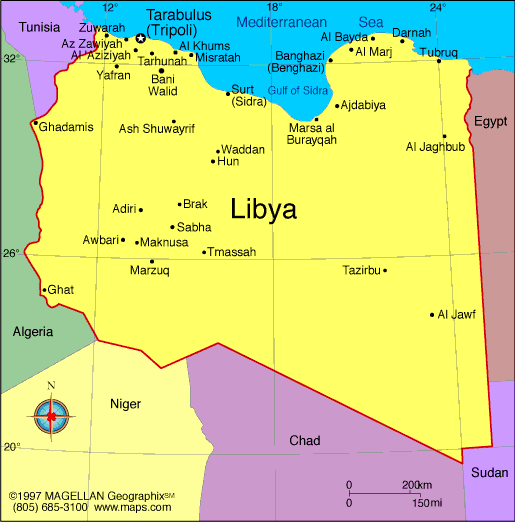
15-year Anniversary of Abu Salim Prison Massacre

June 28th, 1996 Qaddafi's men enter the Abu Salim Prison and murder over 1,000 political prisoners.
The truth came to light slowly and my first encounter with this information came while I was researching through the archives of the Economist Intelligence Unit. Here is the story as told by the Human Rights Watch.


In the summer of 1996, stories began to filter out of Libya about a mass killing in Tripoli's Abu Salim prison. The details remained scarce, and the government initially denied that an incident had taken place. Libyan groups outside the country said up to 1,200 prisoners had died.
In 2001 and 2002, Libyan authorities began to inform some families with a relative in Abu Salim that their family-member had died, although they did not provide the body or details on the cause of death. In April 2004 Libyan leader Mu`ammar al-Qadhafi publicly acknowledged that killings had taken place in Abu Salim, and said that prisoners' families have the right to know what took place.

In May 2005 Human Rights Watch visited Abu Salim prison, run by the Internal Security Agency. Head of the agency Col. Tohamy Khaled said the government had opened an investigation into the 1996 incident, but did not provide information on the manner or timing of the investigation. Human Rights Watch subsequently asked the Libyan government for details on the investigation, but the government failed to reply.

Prisoners in Abu Salim prison interviewed by Human Rights Watch in May were unwilling to speak about the incident, apparently out of fear. The interviews focused on their individual cases, and all of them said that conditions in the prison had recently improved.

In June 2004 and again in June 2006, however, Human Rights Watch interviewed a former Abu Salim prisoner who claims to have witnessed the killings. Now living in the United States, where he has applied for asylum, Hussein al-Shafa'i said he spent 1988-2000 in Abu Salim on political charges, but was never brought to trial, and he worked in the prison kitchen in June 1996. Human Rights Watch could not verify his claims, but many details are consistent with a report from a Libyan group, based on another witness account.

According to al-Shafa'i, the incident began around 4:40 p.m. on June 28, when prisoners in Block 4 seized a guard named Omar who was bringing their food. Hundreds of prisoners from blocks 3, 5 and 6 escaped their cells. They were angry over restricted family visits and poor living conditions, which had deteriorated after some prisoners escaped the previous year. Al-Shafa'i told Human Rights Watch:
Five or seven minutes after it started, the guards on the roofs shot at the prisoners shot at the prisoners who were in the open areas. There were 16 or 17 injured by bullets. The first to die was Mahmoud al-Mesiri. The prisoners took two guards hostage.
Half an hour later, al-Shafa'i said, two top security officials, Abdullah Sanussi, who is married to the sister of al-Qadhafi's wife, and Nasr al-Mabrouk arrived in a dark green Audi with a contingent of security personnel. Sanussi ordered the shooting to stop and told the prisoners to appoint four representatives for negotiations. The prisoners chose Muhammad al-Juweili, Muhammad Ghlayou, Miftah al-Dawadi, and Muhammad Bosadra.

According to al-Shafa'i, who said he observed and overheard the negotiations from the kitchen, the prisoners asked Sanussi for clean clothes, outside recreation, better medical care, family visits, and the right to have their cases heard before a court, because many of the prisoners were in prison without trial. Sanussi said he would address the physical conditions, but the prisoners had to return to their cells and release the two hostages. The prisoners agreed and released one guard named Atiya, but the guard Omar had died.

Security personnel took the bodies of those killed and sent the wounded for medical care. About 120 other sick prisoners boarded three buses, ostensibly to go to the hospital. According to al-Shafa'i, he saw the buses take the prisoners to the back of the prison.

Around 5:00 a.m. on June 29, security forces moved some of the prisoners between the civilian and military sections of the prison. By 9:00 a.m. they had forced hundreds of prisoners from blocks 1, 3, 4, 5 and 6 into different courtyards. They moved the low security prisoners in block 2 to the military section and kept the prisoners in blocks 7 and 8, with individual cells, inside. Al-Shafa'i, who was behind the administration building with other kitchen workers at the time, told Human Rights Watch what happened next:

At 11:00 a grenade was thrown into one of the courtyards. I did not see who threw it but I am sure it was a grenade. I heard an explosion and right after a constant shooting started from heavy weapons and kalashnikovs from the top of the roofs. The shooting continued from 11:00 until 1:35.

He continued:
I could not see the dead prisoners who were shot, but I could see those who were shooting. They were a special unit and wearing khaki military hats. Six were using kalashnikovs.

I saw them at least six men on the roofs of the cellblocks. They were wearing beige khaki uniforms with green bandanas, a turban-like thing.
Around 2:00 p.m. the forces used pistols to "finish off those who were not dead," he said.

Abu Salim prison held between 1,600 and 1,700 prisoners at the time, and the security forces killed "around 1,200 people," al-Shafa'i said. He calculated this figure by counting the number of meals he prepared prior to and after the incident.

Cleanup began around 11:00 a.m. the next day, June 30, when security forces removed the bodies with wheelbarrows. They threw the bodies into trenches 2 to 3 meters deep, one meter wide and about 100 meters long that had been dug for a new wall. "I was asked by the prison guards to wash the watches that were taken from the bodies of the dead prisoners and were covered in blood," al-Shafai'i said. In 1999 security officials poured cement over the trench, he claimed, although he believed that they later had the bodies removed.

The only other description of the incident comes from a report by the National Front for the Salvation of Libya, an opposition political group based outside Libya. Drawing on the account of an anonymous former prisoner who witnessed the incident (not al-Shafa'i), the report largely corroborates al-Shafa'is account.

The National Front report says that 120 sick and wounded prisoners boarded buses on June 28 to receive medical care but that many of them were executed, although it provides no details. The next day around 11:00, the report says, "hand grenades were thrown into the crowds of prisoners followed by continuous firing from different weapons like AK-47s, general purpose machine guns, crowd control machine guns. The raining of bullets continued for an entire hour."

The report does not mention trenches but says that refrigerator trucks from the Meat Transportation Company and the Marine Fisheries Company took bodies away. On June 30, a forklift loaded the last bodies into a container for trains. In total, 1,170 prisoners died, the report says, but it provides no names.

The Libyan government has denied that any crimes took place. In May 2005, Internal Security Agency head Khaled told Human Rights Watch that prisoners had captured some guards during a meal and taken weapons from the prison cache. Prisoners and guards died as security personnel tried to restore order, he said, and the government had opened an investigation on order of the Secretary of Justice.

"When the committee concludes its work, because it has already started, we'll give a detailed report answering all questions," Khaled said.

According to Khaled, more than 400 prisoners escaped Abu Salim in four separate break-outs prior to and after the incident: in July 1995, December 1995, June 1996 and July 2001. Among the escapees were men who then fought with Islamist militant groups in Afghanistan, Iran, and Iraq, he said.

A Libyan group based in Switzerland, Libyan Human Rights Solidarity, says that since 2001 the authorities have notified 112 families that a relative held in Abu Salim is dead, without providing the body or details on the cause of death. In addition, 238 families claim they have lost contact with a relative who was a prisoner in Abu Salim.

The organization expressed concern about one of the four prisoner negotiators from June 28, Muhammad Bosadra. According to the group, the authorities transferred Bosadra from Abu Salim to an unknown facility in summer 2005, and no one has heard from him since.

Human Rights Watch spoke with the brother of one former Abu Salim prisoner whom the authorities had informed of his brother's death. According to Farag al-Awani, now living in Switzerland, security agents arrested his brother Ibrahim al-Awani, 25 at the time, from the family home in al-Bayda in July 1995. The family never heard from Ibrahim again.

In 2002, members of Libya's Internal Security Agency told the family that Ibrahim had died in a Tripoli hospital due to sickness. A death certificate they provided, viewed by Human Rights Watch, said Ibrahim had died on July 3, 2001, but it gave no cause of death. Despite repeated requests, the authorities never returned the body, as required under Libyan law. It is unclear if Ibrahim al-Awani died in the June 1996 incident or at another time.

We just want to know what happened and to have the body back, Farag al-Awani said. 

Book Recommendation - Competitive Authoritarianism

Competitive Authoritarianism: Hybrid Regimes After the Cold War
Steven Levitsky, Lucan A. Way
Cambridge University Press, 2010 - 517 pages

Great book for political scientists at the macro level and if you're a democracy advocate its got helpful content. I'm in the middle of it so I don't have a complete review but its been an immense help for me in creating a sort of benchmark for comparison. By examining changes in Egypt, classifying them, and comparing against the author's definition of Competitive Authoritarianism I've been able to form some more advanced predictions of the regime's trajectory.

Notar: Syria and the Palestine Card

Notar: Syria and the Palestine Card: "
Paul Notar writes a guest column for Informed Comment: Palestine: Bashar Assad’s Ace in the Hole?
President Bashar al Assad
I'm testing this morning on the Syrian situation and thankfully Professor Cole posted the above article on his blog. I've tried to memorize it and will use it as the second half of my essay. I recommend it for you Middle East buffs and Arabists.
If the national dialogue business turns into a national belly flop (and I think it will) Mr. Natar's analysis will be right, Assad will try to heat things up with Israel. It is vaguely similar to the Iran/Iraq War in 1980, in that it bought Khomeini the time he needed to consolidate and reorganize the post-revolution forces.

I'm interested to see how Assad purges the military. He's got to if he's going to continue ordering mechanized divisions to rubble cities. The other thing that I'm sure Mr. Notar would like to know is exactly how riled up the Sunni majority is. He mentions the middle-class but what about the lower class who work in agriculture? Dr. Kazziha of the American University in Cairo told me yesterday that four years of drought has left them on the brink of economic failure.

Thanks for reading, look forward to your comments. -Troy

IDF: Some flotilla activists planning to kill soldiers

IDF: Some flotilla activists planning to kill soldiers: "
Army sources tell 'Post' some flotilla participants plan to use chemical weapons; flotilla member: Claims 'are attempt to justify IDF violence.'

I find it hard to believe that anyone is going to use bags of sulfur to attack soldiers with machine guns because it would surely get them killed. I'm following this story closely now because it looks like its going to be a repeat, hope no one is killed. Another sad and ironic saga for a country with so many families of holocaust survivors. I have no sympathy for them any longer because they have passed it forward. This all goes away if you stop the mass punishment of Gaza.

Monday, June 27, 2011

Flotilla 2 - You've been warned

It really is shameful how obedient the US State Department is to Israel. Five days ago they decided to reaffirm that commitment by issuing a statement regarding the flotilla of aid laden ships that will sail to Gaza this month.
"Previous attempts to enter Gaza by sea have been stopped by Israeli naval vessels and resulted in the injury, death, arrest, and deportation of U.S. citizens. U.S. citizens participating in any effort to reach Gaza by sea should understand that they may face arrest, prosecution, and deportation by the Government of Israel. The Government of Israel has announced its intention to seek ten-year travel bans to Israel for anyone participating in an attempt to enter Gaza by sea. On May 31, 2010, nine people were killed, including one U.S. citizen, in such an attempt. The U.S. Embassy in Tel Aviv and the U.S. Consulate General in Jerusalem are not able to provide consular assistance in Gaza or on the high seas or coastal waters." -State Department Travel Warning 6/23/2011 link
The blockade of Gaza is illegal and immoral (40% of the 1.5 million are children) and last year when activists tried to break it their ships were boarded by Israeli soldiers and nine people were killed including one American. A handful of members of Congress have written a letter to the State Department asking for their help in making sure that doesn't happen again. If you're representatives didn't sign the letter you might ask, why?

Alice Walker, author of "The Color Purple"
Risking the Israeli attack is Pulitzer Prize winning author Alice Walker, who is one of  50 Americans who are participating. Collective punishment of Palestinians is wrong and for what? Because Hamas won free and fair elections in 2006? Because a small few continue to use violence against the Israeli occupation?

Libya - ICC Warrants and strange opinion from The Atlantic

Rebel forces have reached Misratah

Today the International Criminal Court  produced arrest warrants for Qaddafi, his son Saif Qaddafi, and the military intelligence chief Abdullah Senussi. This matters as the ICC has been struggling for legitimacy and truly needs to prosecute these criminals but that's not likely as NATO and the rebels are clearly trying to kill all three. France and the UK have begun using attack helicopters, successfully covering a rebel advance to Misrata.

You are kidding yourself if you thought NATO wasn't trying to kill Qaddafi.And you really had to be kidding yourself if you thought the TNC Rebels aren't trying to kill Qaddafi. NATO long ago exceeded its original mandate in UN resolution 1973 which called for a No-Fly-Zone and the protection of civilians.

What happens if/when one of them succeed? Max Fisher from the Atlantic makes an argument that the death of Qaddafi will cause the country to become embroiled in civil strife. Unlike what is happening now?

NATO is not trying to start a civil war, it's trying to end one by helping the side that almost everyone in the free world is hoping will prevail. NATO is seeking a regime change in Libya and so are millions of Libyans. Obama, Sarkozy, and Cameron want a authoritarian dictatorship to be replaced by a democratic republic and I think their approach has been correct and so do Libyans. NATO wishes that more of the strikes could be conducted by Libyan rebels and so do Libyan Rebels.

The evidence Fisher presents is that no national identity exists in Libya because it is a young nation state and that a political vacuum will be created when he takes that final tuk-tuk ride.
"Qaddafi's death would risk imploding what remains of the country's leadership, leaving senior military officers suddenly rudderless and face with the difficult choice between continuing the fight against the rebels, joining them against whatever remained of the regime, or, more likely, turning on one another in a race for power." - Max Fisher, The Atlantic
Saif Qaddafi
But how Mr. Fisher gets to this conclusion is strange. For what power are these rudderless officers vying, control over of a sinking ship? Is he assuming that the TNC/Rebels will put down their guns when Qaddafi dies and NATO will stop the air strikes?

When Qaddafi dies his loyalists will really have two options: Continue fighting or not. Whether they jockey for power among themselves is irrelevant because whoever rises to the top will either surrender or not. The fighting isn't going to end until the TNC/Rebels have a firm grip on the countries coercive elements. The rebels may be "dubious" as he writes but they're the only horse in town.

Fisher then undercuts his own argument by telling us the Qaddafi-dead environment will lead to tribal  fighting that will leave many more dead like it already has in Misrata.

"The question is whether we want to risk a nation of Misratas." ends Fisher.
No, its whether you want to prolong the civil war or end it. Qaddafi's death is better than Qaddafi being allowed to continue ruling which is what I think Fisher would advocate if he tried but he doesn't tell us what ought to be done, only what ought not be done.

Wary of militancy and a escalation of NATO airstrikes? They're working-
"In late May the rebels offered an amnesty to government troops if they defected. The move appeared to have worked when eight senior army officers appeared on May 30th in Rome, announcing that they had abandoned the Libyan regime. The officers, who were the most senior of a group of some 120 soldiers, had been supported in their defection by the Italian intelligence services. One general claimed that the Libyan army had been reduced to one-fifth of its original size. Clearly disaffected with Colonel Qadhafi, they accused him of waging genocide against his own people and argued that he would not be able to remain in power for much longer." Economist Intelligence Unit 6/13/2011
Protesters in Ben Ghazi on March 31, 2011
The new government will have the difficult task of creating an economy and political structure from scratch but it will have considerable international support and access to billions of dollars in foreign reserves that have been frozen.

Saturday, June 25, 2011

What to do in Libya


Observers are calling the situation in Libya a stalemate and wondering how Obama, Cameron, and Sarkozy can break it. Citizens in the respective NATO countries are wondering why do we care what happens in Libya? And, how long will my country keep spending money to fight Qaddafi? Politico’s are trying to answer those questions and its brought them to decision points.

The first decision is whether or not Qaddafi has to be killed, captured, or sent into exile. Or can an arrangement can be made just for the short term in which Qaddafi stays in power but the hostilities are ended?

If you look at what's being said in Washington, London, or Paris it's clear that they’ve chosen the gone as soon as possible and this is also what the Transitional National Council wants. But they’re rethinking this and so are independent policy analysts like Ricardo Alcaro.

It’s easy to see that the big countries thought they were going to score an easy win in the Arab Spring and use it to regain some legitimacy in the Arab world. Initially it looked like Qaddafi’s regime wasn’t going to last long, when Libyan fighter jets defected to Malta and every couple hours so and so resigned it seemed imminent.

But holy smokes folks those boys in Tripoli wove a tight network around their militias. Despite almost the entire world being against the Qaddafi these soldiers are still fighting for him. It’ll be awhile before we know exactly how they’ve created the cohesion necessary but for now its enough to know that it looks like their going to stick it out to the end.

Back to the present situation, if we continue on the “Qaddafi must go” road the coalition has three basic options for breaking the stalemate and achieving its goals.

1. Increase the amount of strike sorties being flown by NATO warplanes.
2. Foreign forces enter Libya and defeat Qaddafi Forces, the Boots on the Ground option.
3. Give the rebels the capability to defeat Qaddafi Forces by arming them with more advanced equipment.

The first option is the default one but it doesn’t guarantee success. Qaddafi Forces have already learned to operate while being pestered by the air strikes. They use the cities to shield themselves because they know that the republics hate to be responsible for collateral damage.

The second option is a non-starter for the West because they’ve all been beaten up for the Iraq and Afghanistan occupations. Of course there are a few special advisers on the ground directing air strikes but what’s needed is the classic ground force of infantry, armor, and artillery to rout Qaddafi’s men. It would be fantastic if we could get the Egyptian Army to do this. They’re the only Arab military that could reasonably do the job and they need the experience but they’ve got their hands full with running post-Mubarak Egypt.

The last real option is to get the rebel forces trained and armed. Not just rifles though, they need tanks and armored personnel carriers and heavy weapons. I got upset a few months ago when Hilary Clinton proposed arming the rebels because it clearly violates United Nation’s Resolution 1970. How many times is the west going to twist international law?

Now back up to the first point of departure. The other road leads to a break in the stalemate that doesn’t rest on a Qaddafi being killed or captured. There are two plans I’ve seen that might work in bringing about a positive end. The first is called National Reconciliation and includes political negotiations with Qaddafi for a transitional period overseen by him and the TNC that would lead to an election in which Qaddafi and his loyalists would be eligible candidates. There are infinite variations of this plan but you get the gist. Qaddafi would be forced to compete and share power.

The other option on this road is to partition the country into two or three states along some old lines that Libyans know. You’d have a new country called Cyrenaica with a capital in BenGhazi and you’d have Tripolitania run from Tripoli and maybe the south breaks off. The argument I’ve heard for this rests on it giving the TNC time to build effective institutions like a real military and an economy that would enable the East to retake the West at a later date possibly without using force.

You probably feel boxed in with these choices, none seem to be the sure thing and you’re wary about more innocent people dying. You want Qaddafi out of power and you want the killing to end. If him and his cronies would just go this would be easy but they won’t and despite what David Cameron says time is not on the coalition’s side.And personally I'm against splitting the country because there are people in the West who want to live without the mad dog as a boss.

My opinion is laced in this article but let me be explicit. I want the rebels armed and trained and able to do what's necessary to get this nation back on track. I would prefer it to be done legally and that would require the United Nations stamp of approval but in the absence of that… The Soviet Union's invasion was defeated by the Afghans only after they were able to neutralize the MI-24 helicopters that they called Satan’s Chariot. That required Stinger missiles. In the Libyan context it's not helicopters that the rebels can’t defeat, it is the armored personnel carriers and tanks.

The US has been using a really fantastic anti-tank weapon called the Javelin. I think it would be the right weapon to see the TNC controlled rebels fielding against Qaddafi’s forces.


Saturday, June 18, 2011

Saudi's Buying Lots of Military Hardware

King Abdullah of Saudi Arabia w/ US President Obama
You know about the campaign to get women the right to drive cars in Saudi Arabia and you read that the Saudi King has decided to spend $130 billion to keep the population from asking for political and human rights. The Saudi regime is also buying something else.

According to the United States' Defense Security Cooperation Agency (DSCA) the Saudi government has just requested $350 million in new light armored vehicles. These LAV-25 series armored vehicles are really great for repelling attacks from Yemen or, if you're not being invaded, for driving over to your neighbors' kingdom to smash a peaceful protest. Here's the DOD press release dated June 13th, 2011. link

Saudi Arabia wants new armored vehicles from the US
Somewhat ironically the DSCA memo says that:
"This proposed sale will contribute to the foreign policy and national security of the United States by helping to improve the security of a friendly country which has been, and continues to be, an important force for political stability and economic progress in the Middle East."
Which is complete rubbish, all the monarchies in the Arab world are getting ready for the end of a political battle that will end in an actual battle. Republics are on the rise and the monarch's are scared. That's why the King's of Morocco and Jordan were suddenly offered membership in the Gulf Cooperation Council. Why would Jordan and Morocco want to join a regional security alliance in a region it doesn't exist in? The gulf states are saying "before you get overthrown by your people, give them some of our cash and if that doesn't work we'll send the troops." Why, because foreign investment in the gulf doesn't sound so good if they do.

Now that Egypt, Tunisia, and Libya are going to be actual democratic republics (fingers-crossed) the monarchs are scared of the "diffusion" of political rights from the Arab republics into their kingdoms. Political scientists use the diffusion mechanism to explain why democratic transitions are wave-like. The Arab Spring, the 3rd wave, the Colored revolutions, are all evidence that ideas flow across borders and the Gulf monarchs know it.

The US's international image looks bad right now and I think we need to start paying more attention to what we're doing especially in the Middle East. Looking the other way on what happened in Bahrain was wrong and whatever State Department is doing in Cairo is shaping up to be a fiasco. Selling military equipment to the monarchies isn't helping and will inevitably be used to deny our Arab brothers and sisters their rights to self-determination.

For further reading see One Nation Under Oil - US Military Reliance on Fossil Fuels

Tuesday, June 14, 2011

A Guide to Recognizing your GOP presidential candidates (Part 4 ) and Debate thoughts


Michelle Bachman, U.S.Congresswoman 6th District of Minnesota

What makes her different: She is the only woman in the race (thus far), is the Founder of the Tea Party Caucus within the U.S. House of Representatives

Recent goof: Her first big shot at national exposure was this response to President Obama's State of the Union address in January. Her lack of eye contact with the camera made her speech a punchline for awhile (still not as bad as Bobby Jindal in 2009.

In 2008 she dropped this gem. She comes off as totally oblivious to where Chris Matthews is going with his questioning. She walked right into his trap and tacitly endorsed McCarthyism. I think she has improved since then in her public appearances but she still comes off as a bit odd to most people (and that is not even including her policy positions).

Probable drop out date: She used last night's debate as a good starting point to prove she is a real contender. She also is full of optimism/delusion, I say she plays the Huckabee role- might win an early primary but bows out around April.

Speaking of the debate last night, the seven candidates did their best not to say anything stupid or anything that could be contradicted later. This is how most political debates operate anyway, but these early ones make it obvious that not screwing up is the strategy.

Monday, June 6, 2011

New Polling Data - Egypt

by: Troy Carter

Cairo is Egypt's mega-city, population 20 million
Cairo: USAID has funded a public opinion poll in Egypt that shows democracy a bit lower on the priority list than some expected. The poll had a legitimate sampling size and method, it will allow analysts to set benchmarks and help the liberal politicians that the US government supports to build a populist agenda. Interestingly it seems that Saudi Arabia, the US's ally, seems to be working against the US efforts by allegedly supporting conservative Islamist groups in the country.

Confirming what many hoped- 94% of Egyptians feel that Mubarak leaving power was good for the country. It's significant to see that confirmed by data because it reveals how unrepresentative the pro-Mubarak demonstrations are.

The results also show that an air of optimism is lingering with 89% of the population feeling positive about the future despite the fact that 41% of Egyptians are struggling for survival. What makes them optimistic? When they see Al Jazeera reporting high-profile regime members has been put in prison and are being tried by the beloved justice system.

Have that with a grain of salt- Egyptians moods will turn sour quickly if the unemployment problem isn't changed soon, it is listed as the top priority for the future government. Speaking of future governments the survey will simultaneously worry and relieve politicians.


Only 2% of the sample said they were ready to vote for the islamist Muslim Brotherhood. But liberals have no reason to celebrate as a whopping 65% said they were unsure who they would support and a number of  nationalist parties are ready to steal liberal votes. Combine the electorates dismal education and the high level of religiosity in Egypt makes the parliamentary elections a toss up. My gut is telling me that we're going to see the Muslim Brotherhood get just under half the parliament and a mixed-bag liberal front fall in with 30%

Last week New York Times columnist Thomas Friedman advocated for President Obama to push Egypt's Supreme Council of Armed Forces to postpone elections. It appears that despite the attention the public isn't hearing it (Friedman isn't on Al Jazeera), only 21% think that September is too early for elections and a decent number think that elections should be held sooner.

That's no news for the Muslim Brotherhood and bad news for liberals. Now that they've got the date set the SCAF and the Muslim Brotherhood will both be working hard to get the right people into power. If liberals are able to build a coalition they might have a shot at balancing the spectrum. I'm not afraid of a MB government, just skeptical that they'd accomplish anything, but the first parliament will be so important in setting the constitution and the presidential elections.
Arab proverb "Break my heart but don't come near my bread." 
Egypt: world's largest wheat importer
My hope for Egypt lies with the low-income working class, a group so large and so potentially politicized. They've fought and won jobs only to get paid dismal salaries. 23% of folks in Egypt say wages are among the top three priorities after unemployment and security. However the state has clamped down on labor action and workers seem to be having trouble forming real unions. This is compounded by the SCAF's recent increase in state subsidies as they try to keep the population from conducting a real revolution.

The liberal electoral agenda will need to begin with jobs and security messages that highlight the Muslim Brotherhood/Salafists inability to develop even a simple plan for the future. I expect we'll see liberal and leftist campaigns hammer the Muslim Brotherhood for betraying the revolution just when it got started but will stay away from criticizing the SCAF. And why go out on a limb when citizen journalists are writing furiously about the military's post-Mubarak actions. The Muslim Brotherhood agenda will likely focus on socio-religious issues with nationalist undertones since its hard to distill economic plans from the Quran.


Naguib Sawiris
The survey challenged the mainstream media narrative that Twitter and/or Facebook were key to the uprising. Only 6% of Egyptians said they got news from social media and most don't have access to the internet. Adding to injury it seems only 28% of people participated in the revolution, I had calculated a much smaller number. Last Laugh - An Egyptian friend of mine told me "voters are just waiting to see if (billionaire) Naguib Sawiris is going to buy their votes."