Showing posts with label #jan25. Show all posts

Sunday, July 10, 2011

World Population Day & Egypt

Today is World Population Day, an event that was created in 1987 in what was then called Day of 5 Billion which was organized to bring attention to Earth's rapidly growing population. The event was made an annual one and became what we recognize today.

This year the world's population is expected to reach an astounding 7 billion and on some days in Cairo it feels like everyone of them is driving a car on the 6th of October Bridge or shoving into a subway car at Sadat station.

Egypt's population is 82.9 million people according to the World Bank's data. At its current growth rate the population will likely reach 160 million by 2050. This makes Egypt the most populous Arab country, with Sudan coming in a distant second, and the third largest in Africa. (Even after the breakaway of the south, Sudan will probably be slightly more populous than Algeria which has a population of 34.9 million.)

Casual observers believe that overpopulation causes poverty but it is the other way around. Poverty is the fuel of population growth. If the state and civil society effectively address the wide-spread poverty in Egypt, population growth will slow or stop.

Probably the quickest way to both slow population growth and address poverty would be to focus on primary education, particularly that of girls. Female Egyptians are arguably the countries most maltreated resource, by unlocking their potential with education and improved health care Egypt's progress on tackling multiple issues will dramatically accelerate.

And frankly if the Central Asia Institute can make headway in mountainous villages of rural Pakistan the job in Egypt should be relatively easy, especially so with the recent outpouring of young Egyptians who are literally begging in Tahrir Square for a chance to lead. The global youth are the most interconnected and technologically sophisticated group in the history of the world and the only thing standing in their march to progress is the remnants of an outdated, authoritarian regime.

But aside from reforming and properly funding the education system, Egypt needs to adopt serious family planning policies and build institutional capacity to make sure that every child is wanted and that reproductive health is maximized.This means we need to work together to break the stigma of contraception and make sure costs are not prohibitive.

But World Population Day isn't just about slowing the swell of humanity, its about realizing that we share one world, the environment, and the way we treat it effects everyone. Future generations will be saddled with the problems that we're creating today and furthermore our own health is risked by living in Cairo, a smog and dust choked city who's air quality sets the bottom of the scale.

And speaking of Cairo, the next generations of Egyptians won't be living in the Delta or Upper Egypt, they'll be living in cities. Imagine the chaos of a future Cairo that isn't 22 million but 40 million. This underlines an important point, the city needs to adopt a 50-year master plan for renovation, growth, and sustainability now.

All this leads back to where Egypt is today and reinforces the need for a radical change in the political system. The presidential system of governance in which the presidency has king like powers of decree and can completely disregard the will of the people must be discarded. Egypt's new constitution must give the people the ability to regularly guide the state's policies and priorities through a strong parliament and an unbiased press that will shine light into the depths of corrupt and illegal behavior. Realizing this, that World Population Day is inherently connected to political freedom its easy to see that Tahrir Square in Cairo gives the fight against overpopulation its greatest expression.


Saturday, July 9, 2011

Police Officer Assassinated in Cairo

According to sources a police officer who had murdered several people in the city of Suez during the January 25th revolution was shot and killed today with a handgun.

After 14 Suez officers were acquitted of murder charges last week thousands of people began to execute civil disobedience plans with protests and labor strikes. The bereaved father of one young boy who was killed by an officer called in to Egypt's most popular talk show and promised that he would kill the policemen himself since the state was failing to convict them of any crimes.

At this point we have no indication that it was in fact an assassination carried out by a party from Suez but clearly the intent and motive to do so is present.

Several revolutionary youth have expressed the need to start killing members of the old regime since the state was failing to meet their demands. And others are predicting that this is the beginning of a string of assassinations that will likely include government ministers and security forces.
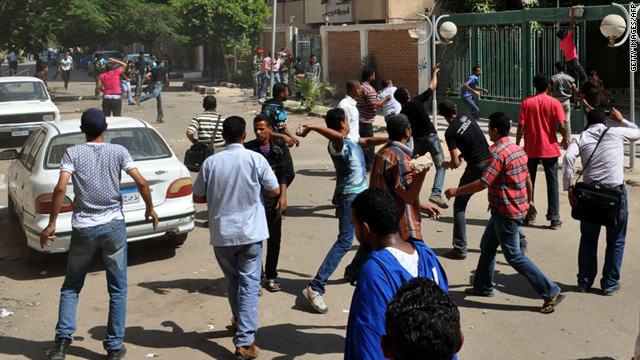
Attacking the police headquarters in Suez on July 7th - by Getty Images
 At this time all political groups are disavowing violence and continue using non-violent tactics like sit-ins, it is unquestionably true that many citizens feel that the regime has not fallen and is now being propped up by the military's Supreme Council of Armed Forces who took control of the state on February 11th.

On Friday political groups calling for a mass rally attracted hundreds of thousands of Egyptians to take to the streets and squares in numerous cities. The protesters demands were for the speedy trials of those responsible for killing protesters, the dismissal of the State's Attorney and the Minister of Interior for incompetence, and the end of military tribunals which have been used to sentence thousands of civilian protesters to years in jail with a complete disregard for existing judicial norms and civilian courts.

Among the numerous groups participating Friday was the Muslim Brotherhood who decided that they would go to the rally but did not condone the sit-in that is still taking place. At the time of this writing there are approximately 15,000 people still sitting in Tahrir Square.

If Egypt's SCAF does not move quickly it is likely we will see an immediate increase in the amount of political violence as well as a massive decrease in the military's legitimacy. Legitimacy it depends on to enforce the timetable that it has largely dictated and to protect its economic interests.

Egypt's military industrial complex accounts for 15-20% of the entire Egyptian economy and the chairman of the SCAF is also the Minister of Military Production, Field Marshall Tantawi.

While the military's budget is a state secret, respected analysts believe that it is about $5 billion, of which $1.3 billion comes directly from the United States.

Earlier this year the military's legal representative was quoted in newspapers as seeking an extra-constitutional status for the military so that no civilian governor could attempt to control its business or military operations.

The current Prime Minister, Essam Sharaf, is set to speak shortly but no one is expecting anything substantive to be announced. Many observers including myself believe that Sharaf's best decision would be to resign immediately if he wants to keep any of the popular support that was shown for him when the SCAF announced his filling the position in March.

Wednesday, June 29, 2011

Cairo June 28th & 29th - SNAFU

Last night I got a BBM - this was the beginning of a strange night.

Then all hell broke loose when the police decided to arrest people who were at the Balloon Theater, relatives of people who had been killed during the uprising in January & February. This absurdity caused a larger group of people who had been protesting for the speedy trial of the former Minister of Interior (recently postponed) to demand the prisoners release at the MOI building.

Egypt's Central Security Forces under the control of the current MOI then attacked the protesters and an all night battle for the streets began with thousands of citizens flowing into Tahrir Square and the area surrounding the American University in Cairo's downtown campus, adjacent to the MOI.

Over the night dozens of people were arrested and will now be sentenced to jail by a military tribunal. Many of are those same family members of the first uprisings casualties. link

After struggling to say something clever for several hours-
I managed to make it to the front line where I was greeted with CS gas and then actually witnessed a man running down the street on fire. I snapped some BB photos. They're gruesome so be warned. His back is badly burned Photo 1 - Photo 2

The fighting seems to be propelled by the government's belief that the protesters will burn down the Ministry of Interior and certainly some of the protesters want to do that. I was able to follow a group of about 300 civilians as they fought their way to the Ministry under heavy police fire and gas to confirm that it was their destination. When we reached the MOI we saw that the military police and an APC were trying to ward off the advance. It was immediately clear that the military was supporting the police. Sorry these photos are poor quality Photo 3 you can see the APC in the distance as we fought into the MOI compound.
 --
Ok and finally after I tell a really bad story that's full of holes I want to make a point. In 1952 the Prime Minister of Iran was Dr. Mohammed Mossadegh and like the Prime Minister of Egypt today, he had no control over the military. The Shah did then and presently here in Egypt the Military is totally independent from any politicians. The Egyptian military is a political institution in and of itself so you see there are some loose similarities.

I'll help out those whose Iranian history is dusty. Mossadegh demanded that the Shah give him control of the military. The Shah balked so Mossadegh resigned.
July 18, 1952 - NY Times

This caused the largest street demonstration in Iran that had ever occurred. Hundreds of Thousands took to the street in support of Mossadegh and it worked.
July 20, 1952 - NY Times
Mossadegh won the day and was reinstated with a much greater power position.
July 23, 1952 - NY Times

The reason I recount this story is because I want Egypt's Prime Minister to do something similar instead of kowtowing to the military. The current Prime Minister of Egypt is so spineless that he left the country when it was arguably facing its biggest crisis since January 28th. If not him then somebody else needs to strip the military of its special status and end all the injustices that its been complicit in creating.
--
p.s. It's neat to see how anti-Mossadegh the NY Times was back then. Rhetorical question: Do they still publish propaganda?

Monday, May 9, 2011

Egypt Falling Asleep Again?

In Cairo, Kamelia Shehata was on TV Saturday night to let the world know that she did not convert to Islam as was the rumor around Egypt. She's even managed to stay married to her loving husband who is a Coptic priest.

I say did not in the first sentence because she might soon given how rationale fundamentalist Muslims are behaving.

The actual rumor was that Shehata left her husband and converted to Islam but was then kidnapped by agents of the Coptic Church who were relentlessly moisturizing the zabiba that may or may not have formed. For a few months this story has been fueling protests by Muslim groups who were calling for her release.

"I was born Coptic and will die Coptic. I was never held by the church at any time." Shehata told Al-Hayat TV. The actual reason she "disappeared" was because she and her family were worried that the same Muslim groups would come kidnap her.

Probably a reasonable action given that someone altered a photo of her wearing a head scarf. Which seems to be a trend now, recently we had the fake photo of Osama bin Laden, and before that Ahram photo of Mubarak striding in front of Obama.

A fake photo of Kamelia Shehata wearing an Islamic head scarf
Her attorney Naguib Gobrael is an unprofessional idiot so I'm not surprised she decide to appear on TV instead of going to a court to clear up the whole ordeal. Gobrael childishly chastised his client in an interview with Daily News Egypt.
"I know she is under severe psychological pressure, but I cannot move on with her case if she is taking decisions without consulting with me.”
Full stop

Were we dreaming? Did Egypt not collectively revolt against its corrupt regime? If we were and this is the Egypt I really live in put me back to sleep because that was a great dream.

Metaphor overload- Egypt is either falling back asleep or never woke up. This kind of action is counter-productive. If the people go back into that state of muted discontent, political apathy and strange obsession with personal status we can expect New Egypt to be no different than old Egypt.

So what is there to bring us back to that Egypt we fought for on Jan. 28th?

We can start by prosecuting Hosni, Habib, and the rest of the gang that acted outside the law for so long. If it takes a street action to make that happen then Yella. The trial needs to happen soon not only for Egypt but to boost the freedom movements in Libya, Syria, Yemen, Bahrain, Saudi, Tunisia the list goes on. Lets show them the light at the end of the tunnel.

All roads lead to Rome? For Salafists yes, not only are Muslim fundamentalists annoying a harmless Coptic family in Minya but they've decided to purge Imbaba [a district of Cairo] of all the Churchs by burning them down. The sectarian fighting has led to at least 10 deaths in the last few days.

Photo by Samy Waheeb

If you're not a crazy person your roads can lead back to a Rome that isn't burning. Lets bring the countries attention back to things that are far more important like ending the kangaroo court the military is using against civilians. Talk about how the state is still allowing military generals to collect rents from North Coast properties they were gifted by Mubarak. Or talk about something simple like ending the export of gas to Israel at below-market prices or that Emergency Law is still in place.

Anything but this kind of religious hate that divides what were so recently a unified people.

Friday, May 6, 2011

Imbaba Boys

by Troy Carter

Residents of Imbaba fight Mubarak's security  forces in Cairo -Jan. 30th


The media has focused mainly on Tahrir Square and the kids who tweeted the Egyptian uprising. To add to your understanding of what happened in Egypt here's a minute long look at some guys from one of the poorest districts in Cairo facing down armed police. None of them were tweeting, all of them were fighting.


They not only successfully defended the streets of their neighborhoods but thousands of them marched to Tahrir Square to shore up the downtown lines. We recognize the grunts who fought and died in the really tough days and for that we salute the boys from Imbaba.

Author's note: Thousands of women resisted and continue to resist the corrupt regime in Egypt but in the days that I spent in Imbaba I didn't find women in the street.

Monday, April 11, 2011

Blogger Jailed - Egypt Moves Backwards

Maikel Nabil
Today the Egyptian Military Court has sentenced Maikel Nabil, a blogger, to 3 years in jail for criticizing its officers. Within Egypt's blogosphere Nabil is one of the most disliked writers, in part because of his strange pro-Israel stance. He has very little credit and I find it odd that the military chose to prosecute him.

Obviously no state likes to hear its military criticized by its citizens. However, if the military does not care to be criticized then it should stop ruling the country by decree.

Restrictions on free speech will only keep Egypt from reaching the democratic system that it seems desperate for. Vital issues need to be discussed in the public sphere if the country is going to catch up [and keep up] with the rest of the world.

If I was living in a country where the military was dependent on conscription to fill its ranks with young men, I can imagine some people calling for a collective action. This action might be one that managed to keep thousands of young men from reporting for military service. It might be made known in that country that the men would appear for duty if some specific thing happened. Like the trial of a hated criminal or a change in some laws. We can imagine.

Saturday, March 26, 2011

Obama should let the UN broker the Two-state Solution

Britain, France and Germany told the United Nations and the European Union today to propose the outlines of a final settlement of the Israeli-Palestinian conflict that would lead to the establishment of a Palestinian state.

Netanyahu defies Obama
The three European countries, all members of the U.N. Security Council, are pressing for Secretary-General Ban Ki-moon and the European Union to propose a settlement text at a meeting in mid-April of the UN, EU, US and Russia.

President Obama should let them take on the task and back the plan that they come up with assuming it will be a equitable starting point for final negotiations.

The Arab Spring needs to melt the decades of ice that have frozen America's foreign policy in the Middle East. Washington should focus on Egypt right now and build a new policy based on respect and partnership. In part that will require a slight distancing of relations with Israel and letting go of the peace process.

Now that Mubarak has fallen and a new democratic Egypt is defrosting, political parties are forming. Young men and women with remarkably similar ideas will be competing in free and fair elections. Egypt is the most populous Arab country and is a leader in political, social, and economic trends in the region. If Egypt begins to lean more anti-West so will the rest of the Arab states.

As happens between candidates in elections, there will be a great temptation to win votes using foreign policy issues. If two or more say leftist or liberal parties emerge from the January 25th revolt with similar domestic agendas, they may do just that during the campaign leading up to parliamentary elections. Since the uprising in Egypt began foreign policy has been absent from the dialogue, but that could easily change.

No foreign policy issue is more widely known in Egypt than the Arab-Israeli conflict and that may be where competing parties try to distinguish themselves. If Egypt's parties wade into the issue it won't be to see who can better preserve the blockade on Gaza. Quite the contrary, it could easily become a contest of who will do more for the Palestinians.

But to prevent infantile political parties from becoming anti-American vis-a-vis support for Israel, the US should admit that it has lost credibility and allow the UN to be the broker of the two-state solution.

To do so the US must immediately stop vetoing UN Security Council Resolutions that mention Israel. Just like the US veto on Feb. 18 of a Security Council resolution that would have condemned "illegal" Israeli settlements and demanded an immediate halt to all settlement.

The US needs to learn a lesson from the young Arabs that are taking their future in their own hands by breaking with the old policies that lock it into a cold and lonely future. Doing so will help America keep credibility with the young reformers which will be crucial for future security and economic partnerships, never-mind it just being the right thing to do.

Israel and anyone who favors peace in the region stands to gain from the new Egypt. Democratic states are more stable and less likely to make war, commit genocide and violate human rights. Particularly exciting is that it has the effect of reducing or destroying the conditions that radicalize people.

For its own part Israel needs to dunk its head in a cold bucket of water and wake up to the fact that its soon to be surrounded by rationale democratic governments that are going to implement a much different set of foreign policies based on democratic principles. It needs to put its Extreme Right Wingers on ice and shelve its policies of mass punishment. The future is coming faster and faster and it includes law and order based on universal human rights.

Wednesday, March 23, 2011

Winners and Losers: Egypt's Referendum


"We want a new constitution." This woman explained.
Not the old constitution stitched together with changes.
Photo credit: Maryah Converse

Fraudulent no, innefficient yes, historic definitely.

41% of eligible voters turned out, that's about 18 million voters for Egypt's constitutional referendum this Saturday. In the past voters went to the polls if they were paid, fed, or both and the results were always known before the polls even opened. This time we weren't quite sure what the outcome would be but the majority said yes, amendments will be made to the 1971 constitution.

But who were the winners and losers?

The big winner was the military, now that elections are on the short time-table with elections coming this fall, the candidate that protects their wealth has a great chance of getting elected. That candidate will most likely use the campaign machinery of Mubarak's National Democratic Party which the youth have been demanding be dissolved. It wouldn't take much for the military to give it a new veneer.

The loser in this referendum is the January 25th youth coalition and liberal urbanites who supported the ouster of Mubarak. They're still trying to get organized for competition in the parliamentary elections and get a campaign machine built so they can power a reformer candidate in the presidential election.

Who's in an awkward position? The Muslim Brotherhood.

They were the loudest and biggest group to do "Yes" campainging. With 77% voting in favor there's some serious evidence that they hold the key to the palace. While they are probably feeling pretty good about the vote results they're going to see some of their support from the upper-middle class disappear. Their use of religious rhetoric (which they deny), in support of the constitutional amendments insulted many in Cairo and Alexandria.

Again and again we here the Muslim Brotherhood spokesman say they won't run a presidential candidate and won't seek a parliamentary majority. But you can bet your best camel they'll be placing big demands on the presidential candidate they endorse which will probably be the same one the military backs. If word gets out that they're playing footsy with the old regime it could cause a serious backlash.

Surprisingly some liberals went with the Muslim Brothers thinking that its best to get the military out of power as soon as possible. In principle most agree, but where the mainstream of liberals diverge is on the point of who replaces the military. Those who have voted yes are likely to receive a slap in the face when the military decides to stay in power even after the election have been held, an announcement coming soon.

Whatever actually happens, the vote was a very decent step in the direction of democracy and that means accepting the results even if we disagree with them. The worry for many is that it will be a short-lived democracy followed by another autocrat.
--

Wednesday, March 16, 2011

Video: Should Egypt Postpone Elections?

Some Egyptians don't want to be rushed into parliamentary and presidential elections later this year, worried that new political parties won't be on equal footing with the long established. It seems a majority also intend to vote no during this weekends constitutional referendum.


After a discussion, staged by The Doha Debates, an audience of upper-middle class students and professionals voted 84.4% for the motion: "This House believes for the sake of democracy Egypt should postpone elections".

The debate, held at the American University of Cairo's old campus in Tahrir Square, provoked heated arguments between young activists and senior members of the Wafd Party and the Muslim Brotherhood, groups widely seen as participating with the ousted Mubarak regime.


Monday, March 14, 2011

Obama and the Arab Revolts

Since the Tunisian uprising began the Obama administration's response has been characterized in a variety of ways including muted, hypocritical, and even fair. As the dust settles more thoughtful opinions are being formed. Was the administrations response due to an unprepared and outdated foreign policy team? Was it a calculated silence? Weigh the evidence (or not), and let us know what you think.


Sunday, March 13, 2011

How a worm may have stopped a wave. Lebanon's prospects for democratization.

Lebanon has a population of 3.8 million 
As much as anyone might want it to, the wave of democratization that started in Tunisia and gained momentum in Egypt won't do much to change things in Lebanon.

As you may know the political power sharing arrangement in Lebanon is called the Confessional System. No you need not confess your sins before becoming a leader, although that would probably be appreciated. Its called that because power is divided among religious (and ethnic) groups.

In the beginning of the 20th century Lebanon was part of the Ottoman Empire's Syrian territories and after World War I it became occupied by the French mandate.

Back around 1850 the French had became interested in the exportation of silk that was produced from worms living in the Mulberry trees growing on Mount Lebanon. In 1856, a church supported peasant revolt had the effect of growing the Maronite community into a political and economic power as it gained near-exclusive access to European export markets.

In the 1940's the Sunni Muslims of Lebanon (who had access to markets in the east) made an informal agreement with the Maronites called the National Pact. It made Lebanon an independent Arab nation in which the two groups would divide parliament's power at a ratio of six Christians for every five Muslims. Additionally it was agreed that the President would be a Maronite and the Prime Minister a Sunni.

The Taif Agreement of 1989 did restructure the National Pact by allocating some of the Maronite's power to Shi'a Muslims and by taking away the President's power to dismiss parliament.

But according to the decades-old pact, each group still gets certain access. Not only through their parliament members but also top-level bureaucrats, military commanders, ambassadorships all divided and parsed out based on ethnic-religious identities.

So no matter who you are there is someone from your distinct ethnic or religious community who can give you access to the state's resources. And therein lies the key.

In Egypt you have (or had) a strong state that was guarded by a very small elite using a massive internal security force. Most Egyptians have no access to upper levels of government. This centralization of power acted as a focal point for the Jan. 25th revolt.

Comparatively, Lebanon has a weak national government and most have access based on their communal identity. Its weakness comes from the power-sharing and it makes it difficult to organize against. While many Lebanese bemoan the government they do so by relating its failure to the other religious and ethnic groups or outsiders.

Lebanon definitely has its own elites who horde wealth, but unlike their counterparts in Egypt they draw political loyalty from their religious-ethnic communities by distributing power and wealth down accordingly.

The flag of Hezbollah, a Lebanese resistance movement 
And unlike Egypt, Lebanese citizens can express themselves, march in the streets and/or form armed militias. Not only do they not worry about being arrested (not by the state anyway) but they've usually got someone who will listen to them. A far cry from the sort of treatment Mubarak's gang was giving Egyptians.

To reiterate the point, the recent wave of Arab democratization isn't likely to find a home in Lebanon because there is access to state resources and real power sharing. It may not be democratic or very efficient but it manages to work.

What you may find interesting and is worth much more time is that despite the confessional systems durability the state becomes very unstable when an outside actor like Syria or the United States favors a certain group.

--
Note: This is definitely one of those times when it must be said, "I'm sorry I wrote you a long letter, I didn't have time to write a short one." I thanks Professor Walid Kazziha at The American University in Cairo who taught me most of what I know about Lebanon. 

Friday, March 11, 2011

Will Egypt's Military Overrule the First Vote?

Source: Egyptian Cabinet's IDSC
Cairo: The Egyptian Cabinet's Information and Decision Support Center (IDSC) has been running an online straw poll to gauge the reaction to the proposed constitutional amendments that will be voted for on March 19th.

On Friday a member of the cabinet's staff expressed doubt that the amendments will be approved by the people but said, "it will pass anyway." Implying that Egypt's Supreme Military Council (SMC) will either publicly force the amendments or announce fraudulent results.


Since Feb. 11 when Hosni Mubarak stepped down as Egypt's president the SMC has dictated the makeup of the constitutional committee, imposed a curfew, arrested demonstrators, used military courts to sentence civilians, and failed to lift the 30-year old 'Emergency Law' that suspends political and human rights.  


The constitutional amendments were announced by the military on February 26th and the quick scheduling of the referendum is seen by some as a ram-rod tactic to bypass public debate.


An excellent analysis of what the proposed amendments do has been completed by the Carnegie Endowment for International Peace but here are the most significant changes:
  • Candidates will have three ways to get on the presidential ballot: nomination by a party with at least one parliamentary seat; endorsement by 30 members of the parliament; or attainment of 30,000 signatures of citizens eligible to vote.  
  • The president will serve for four years and be limited to two terms. 
  • The president will be obligated to appoint at least one vice president. 
  • The judiciary is returned to active supervision of elections and will be the final arbiter of the validity of legal challenges to results. 
  • The president or half of the members of parliament may call for a new constitution and a 100-member assembly can be convened to draft a new constitution. 
  • The president may declare a state of emergency with parliamentary approval; any extension beyond six months would require approval in a public referendum. 
  • An article setting aside constitutional human rights provisions in terrorism cases will be removed entirely. 
For a complete list of amendments in Arabic or English click here. 

Wednesday, March 9, 2011

Army Breaks Camp in Tahrir

Traffic passes protesters in Tahrir Square on March 7th
Cairo - Unidentified men assaulted several hundred protesters camped in Tahrir Square on Wednesday. Using knives and stones the attackers tried to disperse the pro-democracy forces occupying Egypt's famous square. After a period of tense conflict the Egyptian Army sent troops in to tear down tents and arrest protesters still in the square's center.


Numerous activists involved sent out distressed messages on Twitter, making it clear that the military has decided to end the weeks long sit-in. The protesters demands are not uniform, some want more transparency in the interim government and others, the end of the 30 year-old Emergency Law.


This latest crisis comes during a week of heightened violence. On Tuesday, at least 13 people died and 140 injured in the Muqattam neighborhood. Some are reporting the violence as sectarian but others are convinced the former regime's security apparatus is instigating it.


Officers have also announced a 9PM curfew in Tahrir Square, broadcasting it over loudspeakers. For weeks the curfew has been 12AM and only sporadically enforced.

The actions of the Army seem at odds with their recent decision to sack Ahmed Shafik from the prime minister's office. Shafik was seen as a survivor of the Mubarak regime and intensly hated by the protesters.

In addition, the Army allowed reformers to raid the offices of the Amn Dawla (State Security's Intelligence Bureau). At this point it's unclear as to why the military has changed policy in Tahrir Square.

Egypt's Supreme Military Council has ruled the country since February 11th, the day when the former President, Hosni Mubarak, was forced out of power by mass demonstrations.


Sunday, March 6, 2011

'Million Woman March' planned for Tuesday

Egypt's Tahrir Square on Jan. 25
With many asking why there were no women appointed to the recent constitutional committee, a demonstration has been planned to advance female participation in Egypt's emancipated political arena.

On Tuesday March 8th, International Women's Day will be celebrated in Egypt with a "Million Women March" starting at 3PM in Tahrir Square.

Twenty-one year-old Ain Shams University student Dina Sadiq was demanding political freedom and human rights throughout the protest. In response she received a stone in the back thrown by a uniformed state security officer on Qasr el Aini street. Her and many other women are an integral part of the movement that started on January 25th, will their work be acknowledged?

Remember that in 2005 just four women won seats in a parliament of 454 and in 2009, a new law mandated the creation of 64 seats exclusively for women. A past blog discussed this Feminization of Authoritarianism and the Egyptian parliament's female quota. It was obvious that those 64 who benefited from the quota in the 2010 elections were from the National Democratic Party and did little to advance the rights of women.

In the new Jan. 25th context some questions arise for which we don't have satisfactory answers. Will the next parliamentary elections include the 64 all-female districts? Has the revolutionary moment changed the stereotype that politics are just for men?

Article 62 of the Egyptian constitution, the only one that mentions women, is not to be amended during the March 19th referendum. Without removing it the Constitutional Court won't have grounds to rule against the quota law.
Text of Article 62:
Citizens shall have the right to vote and express their opinions in referendums in accordance with the provisions of the law.
Their participation in public life is a national duty. The law shall regulate the right to stand for election to the People’s Assembly, the Shura Council and the local councils in accordance with the electoral system it specifies. The law may adopt a system which combines the individual member system with the party list system on the basis of a ratio between the two systems to be determined by the law. It may also stipulate a minimum representation of women in the afore-mentioned councils.

And as for the gender stereotyping of politics, there is scant evidence supporting  society has changed. The all-male roster of the constitutional committee gives you an idea of what the Supreme Military Council thinks. Participation in Tuesday's march will give us a reading but the event's page on Facebook is showing little activity. The best evidence will be how female candidates poll in the fall elections.

Regardless, now that voting will effect politics, women will have more power to seek gender specific reforms. Women from all over will be able to participate and can become leaders because of their skill as politicians and merit. Suzanne Mubarak's monopoly on representing Egyptian women is over.  
-- 
Note: Egyptian Women's Day is on March 16th followed closely by Mother's Day on March 22nd.

Friday, February 25, 2011

Video: Thousands Gather in Tahrir on Feb. 25

Hundreds of thousands of Egyptians gather in Tahrir Square. Some celebrating the fall of Mubarak and the one month anniversary of revolution, many others demanding more.


Wednesday, February 23, 2011

Military: Constitutional Reforms Displayed Later Today

Mohammed ElBaradei called for a new constitution in Egypt
The Supreme Military Council of Egypt's member, General Abdel-Moniem Cato, announced that the constitutional reforms will be available today.

Instead of scrapping the undemocratic constitution crafted by Egypt's dictators to ascertain their power the military chose a small committee to draft amendments.

Many activists and intellectuals have called for a new constitution instead of a reform process including Mohammed ElBaradei and Alaa al Aswany. 

This move reinforces earlier analysis that the Egyptian regime once headed by Hosni Mubarak is still actively working to take Egypt back to the structure that gave it complete access to the nation's power and wealth.


Friday, February 18, 2011

US vetoes resolution against Israeli settlements

Cairo: On Friday, President Obama’s administration used its veto power in the United Nations Security Council for the first time.  The move blocked a draft resolution condemning Israel’s continued settlement of the occupied Palestinian territories.

Israel continues to settle occupied East Jerusalem
The draft was backed by each of the 14 other members of the security council and has isolated the United States in the UN as the sole backer of Israel‘s settlement policy.

The backdrop for the vote is an unstable region as governments in Algeria, Bahrain, Libya, and Yemen are battling populist democratic uprisings. The United States which has tried to portray itself as siding with the protesters demands for freedom may be discredited by the vote.

US ambassador Susan Rice said Washington was “regrettably” blocking the draft resolution and warned Israel should not interpret the move as backing settlement policy in East Jerusalem and the West Bank.

Yasser Abed Rabbo, secretary general of the Palestine Liberation Organization (PLO), said the US veto was “unfortunate and affects the credibility of the American administration.”

Israel reacted to the vote by calling for resumption of direct talks with the Palestinians.

The last round of talks broke down last year after Israel restarted settlement and building activity in the occupied territories despite Washington‘s wishes.

British Ambassador Mark Lyall Grant, speaking on behalf of Britain, France and Germany, condemned Israeli settlements in the West Bank. “They are illegal under international law,” he said.

Palestinian leaders say two-state solution peace talks are meaningless while Israeli settlement undermines their future territorial integrity.

The Palestinian Authority decided earlier on Friday to insist that the resolution be put to the council, and rejected an offer from the United States of a council statement containing weaker language on settlement activity.  The US also offered to recognize that negotiations should start from the 1967 borders in the deal.

One senior Palestinian official, speaking on condition of anonymity, told AFP the offer, made in an hour-long phone call late Thursday from Obama, was accompanied by veiled threats of “repercussions” if it were refused.

Since 2000, 14 Security Council resolutions have been vetoed by one or more of the five permanent members of the five permanent members -- Britain, China, France, Russia, and the United States.

Of those, 10 were US vetoes, nine of them related to the Israeli-Palestinian conflict. The last US vetoes were two in 2006, both related to Israel.

Reporting by AFP & Reuters

Thursday, February 17, 2011

Egypt: Why Fear Chaos? Fear the Regime.

But don't you think chaos will ensue?

It's a common countering question to the request that the military regime give up political power and let civilians govern during the transition. It became even more prevalent when the military broadcast a mass text message to Egyptian mobile phones on Feb. 18th saying essentially that.

The argument goes that by allowing civilians to run transitional Egypt the military would have no reason to serve. They would quit protecting the streets by simply going home or back to their barracks. Criminals would then begin stealing everything they could carry.

That may happen but its unlikely since unemployment is an enormous problem in Egypt and the Army is a good job for many, especially for career officers who are well paid.

The new face of Egypt's military regime is General Tantawi
Remember that Egypt has been ruled by an autocratic military regime since 1952 and the call of the Jan. 25 protesters was the downfall of that system. By deposing Mubarak, a palace revolution, the regime has distracted many Egyptians from their core demand.

Instead of letting the civilian protesters build a democratic future, the regime is using symbolic investigations into some scapegoats that will lead to kangaroo courts. Smoke and mirrors that are allowing for the military to consolidate power.

Why couldn't the military announce that it would protect the people from criminals while a coalition of civilians who aren't connected to the regime carry out transitional government functions. Undoubtedly, the patriotism of  everyone below mid-grade officer would ensure the protection of  the people during such a vulnerable period.

Instead the regime is still dictating. It dictated a constitutional committee, dictated a timetable for elections, and is already cracking down on political freedoms hard won during the protests.

By all accounts the timetable the military dictated for elections is too short for the new political society to organize. This favors the regime who already has a party system and platform in place

Why? Top officers might be implicated in corruption, a chance the regime isn't willing to take. Why hasn't the Egyptian prosecutor started a corruption investigation into the Mubarak family?

Don't fear chaos, fear the regime.

Wednesday, February 16, 2011

Freedom: click "like"?

Foreign editors and pundits are utterly deaf to what the events in Egypt mean. A new era in the entire region is coming that seems sure. But for Egypt, the protests have yet to change facts on the ground. It seems the continuation of the military regime is quite possible. Its all speculation at this point. 

Despite not knowing what will come numerous Israeli opinion makers are treating the Jan. 25th movement and the coup on Mubarak like their own 9/11. A life defined by military aggression has made even the slightest possibility of anti-Israeli Egyptians coming to power cause to beat the drums. As usual its the Muslim Brothers who are coming to get them.

Following suit the US media is repeating this nonsense. Please don't wear the lenses that the media wants you to wear. These old glasses only focus on the safety of a tiny country in the most repressive region in the world. Don't ignore the enormous opportunity for civilization to progress in the direction of justice and peace.

Israel possesses a very large and capable military able to defend itself from any attacking neighbor. Egyptians know this, the pundits know this. So ask yourself, why would they scare everyone?

Noticeably its not reporters who went to Egypt to cover this revolutionary moment but arm-chair pundits and editors who are selling the fear. Anyone on the ground will tell you that there is no one saying that Islam is the answer.

The youth who organized and removed Mubarak with peaceful protests are light years away from Islamic fundamentalism. The Muslim Brotherhood, the Israel/US boogeyman, played little part in any of this.

Think critically about your own political system. Christian ideology plays a large role in US politics and Judaism influences policy in Israel. Why should anyone expect Muslims to not play a role in Egypt?

And don't miss the hypocrisy in all this. The US has supported Islamists in Iraq and Afghanistan when it looked advantageous. Did these same editors and pundits care then?

The dethroning of Mubarak was led by young men and women fighting for political and civil rights in a society in which there was little social justice. The Facebook group that announced the start of the protest is called, "We are all Khaled Said," named after a 28 year old blogger who was tortured to death for expressing his opinion about the dictatorship he lived in.

This is not about Israel or the US's interests, which are quite safe. This is about justice and freedom. Are you against freedom?
--
For more on this topic see Professor Juan Cole's article. 

Monday, February 14, 2011

What changed in Egypt?

Military regime by any other name

By Troy Carter


What actually happened in Egypt last week?  It started under the rule of Hosni Mubarak and ended under the rule of a military junta led by Mohammed Tantawi, both representing the same regime.

These are the facts but the celebration on the streets of Cairo masks this reality. What we saw on television belies a much more complicated situation. Simplifying what happened by calling it a revolution is part of that mask.

It was the removal of a figurehead, one man gone within a fifty-nine year old political system that leaves the same old generals carrying out the same foreign and domestic policies.

The military decided to get rid of Mubarak not because a small percentage of the Egyptian population demanded it, but for another reason entirely.

Months ago Hosni Mubarak made his 47-year-old son Gamal the chairman of the National Democratic Party’s Policy Committee. This was a clear sign that the president intended for his son to be the next ruler of Egypt. It caused outrage in the military and all but guaranteed further shame for the Egyptian people.

In 1952 Colonel Gamal Abdel Nasser led a coup against a powerless monarchy. Since then the military has been the institution of power in Egypt. Each president has been a high ranking military officer before serving. But Gamal Mubarak was never in the military, his experience is in the financial sector and his political support comes from the businessmen his father has catered to.
Nasser created Egypt's military regime in 1952

In this light the uprising that began on January 25th is quite convenient for the military. It caused the removal of Mubarak and ended any chance for a hereditary system like the one that ruled before the military.

Democracy is foreign to these soldiers yet they promise its implementation. To do so in the six month time frame they announced would be close to a miracle and will require a new constitution, political parties, candidates, and voter rolls.

Its unclear whether the National Democratic Party has been scrapped but if it hasn’t the military could use it as a decoy in parliamentary and presidential elections. If the regime knows one thing it’s how to manipulate an electoral process.

Today the military signaled its commitment to democracy by announcing a constitutional referendum in sixty days. But even if the military was not sincere it would still have sent that message. What the military regime may be counting on is for the fervor to fade and the anger to subside.

The youth movement who is the force behind democratic reforms is smart and equipped with good tools. They are able to drive events faster than the military can respond and by using non-violent tactics they took the regime to a battle ground where all its strength was useless. They fearlessly fought central security forces only when they needed to and showed more discipline than those they were attacked by.

Furthermore the reawakened Egyptian people know that this fight isn’t going to be short, the coup caused massive celebration but the protester's primary chant called for the fall of the regime, not just Mubarak. The people have left Tahrir Square inspired, only to take their demands to the workplace where organizers are expelling regime cronies and growing the movement to the same size of the mass movement that can truly revolutionize the country.

Whether or not the coup turns into a revolution depends on the ability of the protesters to push the military into a truly democratic system and to stop suppressing political and civil rights. The latter is key to preparing for the former.

Pro-democracy forces can ensure success by keeping democracy their singular focus while continuously and strongly acting against any moves counter to it or to suppress political freedoms. By selling the military leaders on the positive aspects of democracy this might not be as hard as it sounds.