Showing posts with label Foreign policy. Show all posts

Monday, June 27, 2011

Libya - ICC Warrants and strange opinion from The Atlantic

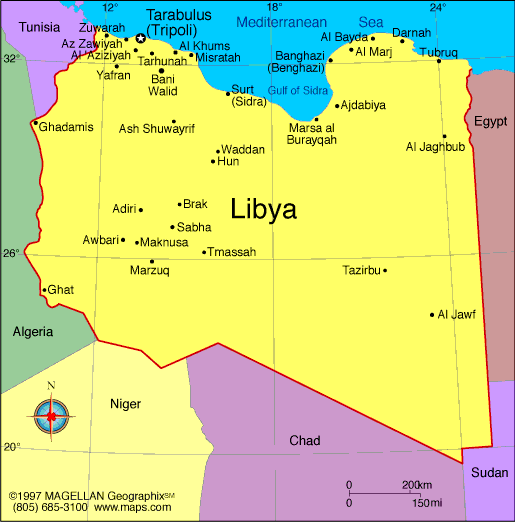
Rebel forces have reached Misratah

Today the International Criminal Court  produced arrest warrants for Qaddafi, his son Saif Qaddafi, and the military intelligence chief Abdullah Senussi. This matters as the ICC has been struggling for legitimacy and truly needs to prosecute these criminals but that's not likely as NATO and the rebels are clearly trying to kill all three. France and the UK have begun using attack helicopters, successfully covering a rebel advance to Misrata.

You are kidding yourself if you thought NATO wasn't trying to kill Qaddafi.And you really had to be kidding yourself if you thought the TNC Rebels aren't trying to kill Qaddafi. NATO long ago exceeded its original mandate in UN resolution 1973 which called for a No-Fly-Zone and the protection of civilians.

What happens if/when one of them succeed? Max Fisher from the Atlantic makes an argument that the death of Qaddafi will cause the country to become embroiled in civil strife. Unlike what is happening now?

NATO is not trying to start a civil war, it's trying to end one by helping the side that almost everyone in the free world is hoping will prevail. NATO is seeking a regime change in Libya and so are millions of Libyans. Obama, Sarkozy, and Cameron want a authoritarian dictatorship to be replaced by a democratic republic and I think their approach has been correct and so do Libyans. NATO wishes that more of the strikes could be conducted by Libyan rebels and so do Libyan Rebels.

The evidence Fisher presents is that no national identity exists in Libya because it is a young nation state and that a political vacuum will be created when he takes that final tuk-tuk ride.
"Qaddafi's death would risk imploding what remains of the country's leadership, leaving senior military officers suddenly rudderless and face with the difficult choice between continuing the fight against the rebels, joining them against whatever remained of the regime, or, more likely, turning on one another in a race for power." - Max Fisher, The Atlantic
Saif Qaddafi
But how Mr. Fisher gets to this conclusion is strange. For what power are these rudderless officers vying, control over of a sinking ship? Is he assuming that the TNC/Rebels will put down their guns when Qaddafi dies and NATO will stop the air strikes?

When Qaddafi dies his loyalists will really have two options: Continue fighting or not. Whether they jockey for power among themselves is irrelevant because whoever rises to the top will either surrender or not. The fighting isn't going to end until the TNC/Rebels have a firm grip on the countries coercive elements. The rebels may be "dubious" as he writes but they're the only horse in town.

Fisher then undercuts his own argument by telling us the Qaddafi-dead environment will lead to tribal  fighting that will leave many more dead like it already has in Misrata.

"The question is whether we want to risk a nation of Misratas." ends Fisher.
No, its whether you want to prolong the civil war or end it. Qaddafi's death is better than Qaddafi being allowed to continue ruling which is what I think Fisher would advocate if he tried but he doesn't tell us what ought to be done, only what ought not be done.

Wary of militancy and a escalation of NATO airstrikes? They're working-
"In late May the rebels offered an amnesty to government troops if they defected. The move appeared to have worked when eight senior army officers appeared on May 30th in Rome, announcing that they had abandoned the Libyan regime. The officers, who were the most senior of a group of some 120 soldiers, had been supported in their defection by the Italian intelligence services. One general claimed that the Libyan army had been reduced to one-fifth of its original size. Clearly disaffected with Colonel Qadhafi, they accused him of waging genocide against his own people and argued that he would not be able to remain in power for much longer." Economist Intelligence Unit 6/13/2011
Protesters in Ben Ghazi on March 31, 2011
The new government will have the difficult task of creating an economy and political structure from scratch but it will have considerable international support and access to billions of dollars in foreign reserves that have been frozen.

Saturday, March 26, 2011

Obama should let the UN broker the Two-state Solution

Britain, France and Germany told the United Nations and the European Union today to propose the outlines of a final settlement of the Israeli-Palestinian conflict that would lead to the establishment of a Palestinian state.

Netanyahu defies Obama
The three European countries, all members of the U.N. Security Council, are pressing for Secretary-General Ban Ki-moon and the European Union to propose a settlement text at a meeting in mid-April of the UN, EU, US and Russia.

President Obama should let them take on the task and back the plan that they come up with assuming it will be a equitable starting point for final negotiations.

The Arab Spring needs to melt the decades of ice that have frozen America's foreign policy in the Middle East. Washington should focus on Egypt right now and build a new policy based on respect and partnership. In part that will require a slight distancing of relations with Israel and letting go of the peace process.

Now that Mubarak has fallen and a new democratic Egypt is defrosting, political parties are forming. Young men and women with remarkably similar ideas will be competing in free and fair elections. Egypt is the most populous Arab country and is a leader in political, social, and economic trends in the region. If Egypt begins to lean more anti-West so will the rest of the Arab states.

As happens between candidates in elections, there will be a great temptation to win votes using foreign policy issues. If two or more say leftist or liberal parties emerge from the January 25th revolt with similar domestic agendas, they may do just that during the campaign leading up to parliamentary elections. Since the uprising in Egypt began foreign policy has been absent from the dialogue, but that could easily change.

No foreign policy issue is more widely known in Egypt than the Arab-Israeli conflict and that may be where competing parties try to distinguish themselves. If Egypt's parties wade into the issue it won't be to see who can better preserve the blockade on Gaza. Quite the contrary, it could easily become a contest of who will do more for the Palestinians.

But to prevent infantile political parties from becoming anti-American vis-a-vis support for Israel, the US should admit that it has lost credibility and allow the UN to be the broker of the two-state solution.

To do so the US must immediately stop vetoing UN Security Council Resolutions that mention Israel. Just like the US veto on Feb. 18 of a Security Council resolution that would have condemned "illegal" Israeli settlements and demanded an immediate halt to all settlement.

The US needs to learn a lesson from the young Arabs that are taking their future in their own hands by breaking with the old policies that lock it into a cold and lonely future. Doing so will help America keep credibility with the young reformers which will be crucial for future security and economic partnerships, never-mind it just being the right thing to do.

Israel and anyone who favors peace in the region stands to gain from the new Egypt. Democratic states are more stable and less likely to make war, commit genocide and violate human rights. Particularly exciting is that it has the effect of reducing or destroying the conditions that radicalize people.

For its own part Israel needs to dunk its head in a cold bucket of water and wake up to the fact that its soon to be surrounded by rationale democratic governments that are going to implement a much different set of foreign policies based on democratic principles. It needs to put its Extreme Right Wingers on ice and shelve its policies of mass punishment. The future is coming faster and faster and it includes law and order based on universal human rights.

Saturday, February 5, 2011

Stop Supporting Mubarak


First published on January 26th in the Sidney Herald

News reports from the Middle East are often grim and for good reason. A 2010 report from the Economist Intelligence Unit says the “The Middle East and North Africa remains the most repressive region in the world.” Idealists who want to promote the spread of political and civil rights (democracy) via the U.S.’s diplomatic leverage constantly have to deal with realists who counter their tactics, claiming that the U.S.‘s economic and strategic interests would be jeopardized. Realists often acknowledge that these rights; such as free speech, right to assemble, the rule of law, are universal and that spreading them would be beneficial. However these same people make assertions based on orientalist cultural claims. In the United States, the realists have more or less won the debate on Middle East foreign policy, but democracy has won the intellectual debate. The U.S. rather openly supports numerous authoritarian regimes with economic and military aid, a paradox that can befuddle the casual observer. Some scholars speculate that this is because the foreign policy system in the U.S. is subservient to the domestic political system ,which has an input/output mechanism favoring dictators because of the short term security they can provide for economic interests. Long term vision is not a variable this system accepts because it might mean short term losses.

The mix of so-called realism, orientalism, short-sightedness, and systemic rigidity hurts the U.S.'s image and place in the world, so much that a far greater danger will emerge eventually. The U.S. needs to change it’s domestic political system, which is characterized by near total control by lobbyists and given little oversight by an uneducated electorate. This change should be immediate as the U.S. nears a new depth of unpopularity in the Middle East. Right or wrong, the “Arab Street” views the American government on the wrong side of the popular democratic ‘Jasmine Revolution’ in Tunisia. The U.S. is further seen as a dishonest broker in the Arab-Israel peace negotiations (courtesy of the  'Palestine Papers'), and to a lesser degree, the 2003 Iraq War. These events play major roles in shaping perception of the U.S. in the Middle East. The sooner Washington policy makers realize the extent of damage already caused and acknowledge the rapidly changing facts on the ground , the better. The U.S. should use its considerable leverage to immediately support democratic reforms in Egypt and bring democratization back to the forefront of the diplomatic mission in the Middle East and North Africa. For many, yesterday’s events in Cairo represent the beginning of a democratic revolution. The U.S. can not afford to wait any longer.

Noted experts on the Middle East, Amr Hamzawy and Nathan Brown, both from the Carnegie Endowment for International Peace, argue that U.S. democratization efforts in the Middle East have wrongly focused on failed or weak states: Lebanon, Iraq, and Palestine. In addition, Hamzawy and Brown say relatively strong regimes in the region too easily resisted the Bush administration. This is true, and the U.S. has been temporarily blinded to opportunities in other places, as evidenced by the State Departments comments on Tunisia. The U.S. has tangible leverage in other countries like Egypt, Jordan, and Kuwait. Steven Levitsky and Lucan Way’s recent book “Competitive Authoritarianism” asserts that the amount of leverage the U.S.. has on these countries is dependent on  three factors: the size and strength of the economy, competing foreign policy objectives, and the so-called "black knights" like Russia, and China who can spoil U.S. efforts with their own foreign policy.

For multiple reasons, some policy makers and many activists dream of liberal reforms in the Middle East, but the entrenched autocrats use the U.S.'s interests in the region to counter democratic efforts. Egypt is a prime example and has been identified as strategically important because it is on Israel’s southern border. Egypt also owns the Suez Canal through which U.S. cargo and warships regularly sail. The Arab world’s most populous country is ruled by a military officer with a police state funded, in part, by the American tax-payers yearly gift of $1.3 billion. The U.S. adopted this policy because Egypt’s regime is quite capable of warding off external demands for democracy. This autocratic regime casts itself  as a “stable regime” and as the best means to protect U.S. interests. This fits in with Levitsky and Way’s model: competing foreign policy objectives have diminished the U.S.’s ability to push for democratic reforms.

The Egyptian people may be on the verge of ousting long time President Hosni Mubarak. The Mubarak regime has ruled with a heavy, torturous hand for 30 years by banning opposition, jailing dissenters, controlling the press, and rigging elections. On January 25th, an estimated 80,000 thousand protesters flooded the streets of Egypt, calling for civil and political rights and for Mubarak's exit from Egypt. The State’s security forces met these demonstrators in a long day of skirmishes. This protest, like the one in Tunisia is not going to be a one day affair. The end is to-be-announced, conditioned on Mubarak joining Ben Ali in exile.

Egyptians themselves have changed their own foreign policy formula. Mubarak's regime is no longer stable and cannot protect U.S. interests in the region. This should not scare anyone. People who know Egypt and who know this movement, will tell you that it is no threat to U.S. interests. It is not a revolution led by global Jihad Inc. or the Muslim Brothers. It is a revolution based on the very ideas found in the U.S. Constitution; that is democracy and individual rights. The Obama administration needs to change its policy, Secretary Clinton‘s recent statement and the President‘s ‘State of the Union‘ speech didn‘t signal any real change. If it does not, the U.S.'s image and leverage will further diminish in the region. U.S. foreign policy makers, particularly realists, need to accept these facts on the ground as soon as possible because democracy isn't waiting any longer. The U.S. can only gain by backing the reform movement in Egypt. Even if the movement fails, Mubarak will continue to support U.S. interests.