After 14 Suez officers were acquitted of murder charges last week thousands of people began to execute civil disobedience plans with protests and labor strikes. The bereaved father of one young boy who was killed by an officer called in to Egypt's most popular talk show and promised that he would kill the policemen himself since the state was failing to convict them of any crimes.
At this point we have no indication that it was in fact an assassination carried out by a party from Suez but clearly the intent and motive to do so is present.
Several revolutionary youth have expressed the need to start killing members of the old regime since the state was failing to meet their demands. And others are predicting that this is the beginning of a string of assassinations that will likely include government ministers and security forces.
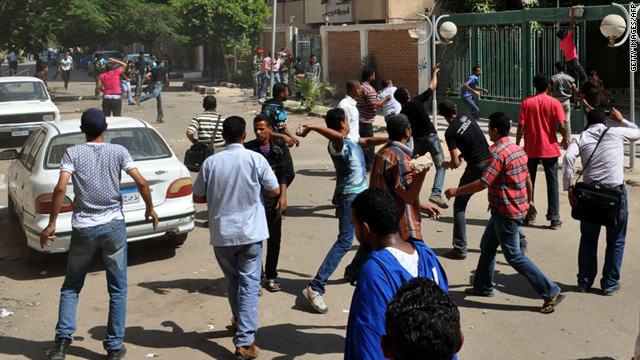 |
| Attacking the police headquarters in Suez on July 7th - by Getty Images |
On Friday political groups calling for a mass rally attracted hundreds of thousands of Egyptians to take to the streets and squares in numerous cities. The protesters demands were for the speedy trials of those responsible for killing protesters, the dismissal of the State's Attorney and the Minister of Interior for incompetence, and the end of military tribunals which have been used to sentence thousands of civilian protesters to years in jail with a complete disregard for existing judicial norms and civilian courts.
Among the numerous groups participating Friday was the Muslim Brotherhood who decided that they would go to the rally but did not condone the sit-in that is still taking place. At the time of this writing there are approximately 15,000 people still sitting in Tahrir Square.
If Egypt's SCAF does not move quickly it is likely we will see an immediate increase in the amount of political violence as well as a massive decrease in the military's legitimacy. Legitimacy it depends on to enforce the timetable that it has largely dictated and to protect its economic interests.
Egypt's military industrial complex accounts for 15-20% of the entire Egyptian economy and the chairman of the SCAF is also the Minister of Military Production, Field Marshall Tantawi.
While the military's budget is a state secret, respected analysts believe that it is about $5 billion, of which $1.3 billion comes directly from the United States.
Earlier this year the military's legal representative was quoted in newspapers as seeking an extra-constitutional status for the military so that no civilian governor could attempt to control its business or military operations.
The current Prime Minister, Essam Sharaf, is set to speak shortly but no one is expecting anything substantive to be announced. Many observers including myself believe that Sharaf's best decision would be to resign immediately if he wants to keep any of the popular support that was shown for him when the SCAF announced his filling the position in March.


