Today is World Population Day, an event that was created in 1987 in what was then called Day of 5 Billion which was organized to bring attention to Earth's rapidly growing population. The event was made an annual one and became what we recognize today.
This year the world's population is expected to reach an astounding 7 billion and on some days in Cairo it feels like everyone of them is driving a car on the 6th of October Bridge or shoving into a subway car at Sadat station.
Egypt's population is 82.9 million people according to the World Bank's data. At its current growth rate the population will likely reach 160 million by 2050. This makes Egypt the most populous Arab country, with Sudan coming in a distant second, and the third largest in Africa. (Even after the breakaway of the south, Sudan will probably be slightly more populous than Algeria which has a population of 34.9 million.)
Casual observers believe that overpopulation causes poverty but it is the other way around. Poverty is the fuel of population growth. If the state and civil society effectively address the wide-spread poverty in Egypt, population growth will slow or stop.
Probably the quickest way to both slow population growth and address poverty would be to focus on primary education, particularly that of girls. Female Egyptians are arguably the countries most maltreated resource, by unlocking their potential with education and improved health care Egypt's progress on tackling multiple issues will dramatically accelerate.
And frankly if the Central Asia Institute can make headway in mountainous villages of rural Pakistan the job in Egypt should be relatively easy, especially so with the recent outpouring of young Egyptians who are literally begging in Tahrir Square for a chance to lead. The global youth are the most interconnected and technologically sophisticated group in the history of the world and the only thing standing in their march to progress is the remnants of an outdated, authoritarian regime.
But aside from reforming and properly funding the education system, Egypt needs to adopt serious family planning policies and build institutional capacity to make sure that every child is wanted and that reproductive health is maximized.This means we need to work together to break the stigma of contraception and make sure costs are not prohibitive.
But World Population Day isn't just about slowing the swell of humanity, its about realizing that we share one world, the environment, and the way we treat it effects everyone. Future generations will be saddled with the problems that we're creating today and furthermore our own health is risked by living in Cairo, a smog and dust choked city who's air quality sets the bottom of the scale.
And speaking of Cairo, the next generations of Egyptians won't be living in the Delta or Upper Egypt, they'll be living in cities. Imagine the chaos of a future Cairo that isn't 22 million but 40 million. This underlines an important point, the city needs to adopt a 50-year master plan for renovation, growth, and sustainability now.
All this leads back to where Egypt is today and reinforces the need for a radical change in the political system. The presidential system of governance in which the presidency has king like powers of decree and can completely disregard the will of the people must be discarded. Egypt's new constitution must give the people the ability to regularly guide the state's policies and priorities through a strong parliament and an unbiased press that will shine light into the depths of corrupt and illegal behavior. Realizing this, that World Population Day is inherently connected to political freedom its easy to see that Tahrir Square in Cairo gives the fight against overpopulation its greatest expression.
Sunday, July 10, 2011
Saturday, July 9, 2011
Police Officer Assassinated in Cairo
According to sources a police officer who had murdered several people in the city of Suez during the January 25th revolution was shot and killed today with a handgun.
After 14 Suez officers were acquitted of murder charges last week thousands of people began to execute civil disobedience plans with protests and labor strikes. The bereaved father of one young boy who was killed by an officer called in to Egypt's most popular talk show and promised that he would kill the policemen himself since the state was failing to convict them of any crimes.
At this point we have no indication that it was in fact an assassination carried out by a party from Suez but clearly the intent and motive to do so is present.
Several revolutionary youth have expressed the need to start killing members of the old regime since the state was failing to meet their demands. And others are predicting that this is the beginning of a string of assassinations that will likely include government ministers and security forces.
At this time all political groups are disavowing violence and continue using non-violent tactics like sit-ins, it is unquestionably true that many citizens feel that the regime has not fallen and is now being propped up by the military's Supreme Council of Armed Forces who took control of the state on February 11th.
On Friday political groups calling for a mass rally attracted hundreds of thousands of Egyptians to take to the streets and squares in numerous cities. The protesters demands were for the speedy trials of those responsible for killing protesters, the dismissal of the State's Attorney and the Minister of Interior for incompetence, and the end of military tribunals which have been used to sentence thousands of civilian protesters to years in jail with a complete disregard for existing judicial norms and civilian courts.
Among the numerous groups participating Friday was the Muslim Brotherhood who decided that they would go to the rally but did not condone the sit-in that is still taking place. At the time of this writing there are approximately 15,000 people still sitting in Tahrir Square.
If Egypt's SCAF does not move quickly it is likely we will see an immediate increase in the amount of political violence as well as a massive decrease in the military's legitimacy. Legitimacy it depends on to enforce the timetable that it has largely dictated and to protect its economic interests.
Egypt's military industrial complex accounts for 15-20% of the entire Egyptian economy and the chairman of the SCAF is also the Minister of Military Production, Field Marshall Tantawi.
While the military's budget is a state secret, respected analysts believe that it is about $5 billion, of which $1.3 billion comes directly from the United States.
Earlier this year the military's legal representative was quoted in newspapers as seeking an extra-constitutional status for the military so that no civilian governor could attempt to control its business or military operations.
The current Prime Minister, Essam Sharaf, is set to speak shortly but no one is expecting anything substantive to be announced. Many observers including myself believe that Sharaf's best decision would be to resign immediately if he wants to keep any of the popular support that was shown for him when the SCAF announced his filling the position in March.
After 14 Suez officers were acquitted of murder charges last week thousands of people began to execute civil disobedience plans with protests and labor strikes. The bereaved father of one young boy who was killed by an officer called in to Egypt's most popular talk show and promised that he would kill the policemen himself since the state was failing to convict them of any crimes.
At this point we have no indication that it was in fact an assassination carried out by a party from Suez but clearly the intent and motive to do so is present.
Several revolutionary youth have expressed the need to start killing members of the old regime since the state was failing to meet their demands. And others are predicting that this is the beginning of a string of assassinations that will likely include government ministers and security forces.
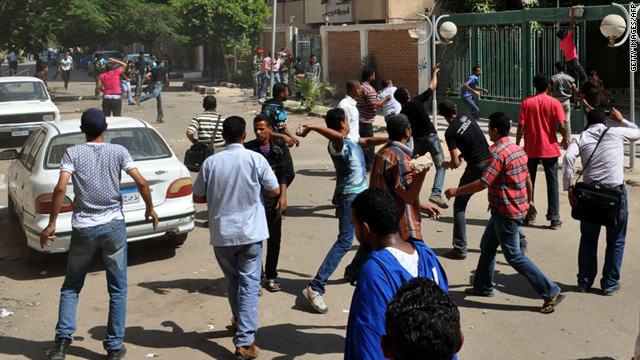
| Attacking the police headquarters in Suez on July 7th - by Getty Images |
On Friday political groups calling for a mass rally attracted hundreds of thousands of Egyptians to take to the streets and squares in numerous cities. The protesters demands were for the speedy trials of those responsible for killing protesters, the dismissal of the State's Attorney and the Minister of Interior for incompetence, and the end of military tribunals which have been used to sentence thousands of civilian protesters to years in jail with a complete disregard for existing judicial norms and civilian courts.
Among the numerous groups participating Friday was the Muslim Brotherhood who decided that they would go to the rally but did not condone the sit-in that is still taking place. At the time of this writing there are approximately 15,000 people still sitting in Tahrir Square.
If Egypt's SCAF does not move quickly it is likely we will see an immediate increase in the amount of political violence as well as a massive decrease in the military's legitimacy. Legitimacy it depends on to enforce the timetable that it has largely dictated and to protect its economic interests.
Egypt's military industrial complex accounts for 15-20% of the entire Egyptian economy and the chairman of the SCAF is also the Minister of Military Production, Field Marshall Tantawi.
While the military's budget is a state secret, respected analysts believe that it is about $5 billion, of which $1.3 billion comes directly from the United States.
Earlier this year the military's legal representative was quoted in newspapers as seeking an extra-constitutional status for the military so that no civilian governor could attempt to control its business or military operations.
The current Prime Minister, Essam Sharaf, is set to speak shortly but no one is expecting anything substantive to be announced. Many observers including myself believe that Sharaf's best decision would be to resign immediately if he wants to keep any of the popular support that was shown for him when the SCAF announced his filling the position in March.
Tuesday, July 5, 2011
Turkey, Syria, and the Kurds
![]() |
| Prime Minister Erdogan with President Assad in June, 2010 |
Remember that Syria and Turkey almost came to blows in the late 90's over the Kurdish population that lives in the borderlands between the two countries. Syria had been mad at Turkey for building relations with Israel and gave PKK leader Abdullah Ocalan safe haven in Damascus.
![]() | ||||||
| New York Times - October 12th, 1998 |
Kurds have been fighting for the right to self-determination or at least to be treated as equals in Turkey for a long time. It's a conflict that might be solved in the near future if Turkey's AKP government is able to form a coalition capable of amending the constitution.
A war between Syria and Turkey could potentially draw Iran, Syria's strategic defense partner, into a broader regional conflict.
Wednesday, June 29, 2011
Cairo June 28th & 29th - SNAFU
Last night I got a BBM - this was the beginning of a strange night.
Then all hell broke loose when the police decided to arrest people who were at the Balloon Theater, relatives of people who had been killed during the uprising in January & February. This absurdity caused a larger group of people who had been protesting for the speedy trial of the former Minister of Interior (recently postponed) to demand the prisoners release at the MOI building.
Egypt's Central Security Forces under the control of the current MOI then attacked the protesters and an all night battle for the streets began with thousands of citizens flowing into Tahrir Square and the area surrounding the American University in Cairo's downtown campus, adjacent to the MOI.
Over the night dozens of people were arrested and will now be sentenced to jail by a military tribunal. Many of are those same family members of the first uprisings casualties. link
After struggling to say something clever for several hours-
I managed to make it to the front line where I was greeted with CS gas and then actually witnessed a man running down the street on fire. I snapped some BB photos. They're gruesome so be warned. His back is badly burned Photo 1 - Photo 2
The fighting seems to be propelled by the government's belief that the protesters will burn down the Ministry of Interior and certainly some of the protesters want to do that. I was able to follow a group of about 300 civilians as they fought their way to the Ministry under heavy police fire and gas to confirm that it was their destination. When we reached the MOI we saw that the military police and an APC were trying to ward off the advance. It was immediately clear that the military was supporting the police. Sorry these photos are poor quality Photo 3 you can see the APC in the distance as we fought into the MOI compound.
--
Ok and finally after I tell a really bad story that's full of holes I want to make a point. In 1952 the Prime Minister of Iran was Dr. Mohammed Mossadegh and like the Prime Minister of Egypt today, he had no control over the military. The Shah did then and presently here in Egypt the Military is totally independent from any politicians. The Egyptian military is a political institution in and of itself so you see there are some loose similarities.
I'll help out those whose Iranian history is dusty. Mossadegh demanded that the Shah give him control of the military. The Shah balked so Mossadegh resigned.
This caused the largest street demonstration in Iran that had ever occurred. Hundreds of Thousands took to the street in support of Mossadegh and it worked.
Mossadegh won the day and was reinstated with a much greater power position.
The reason I recount this story is because I want Egypt's Prime Minister to do something similar instead of kowtowing to the military. The current Prime Minister of Egypt is so spineless that he left the country when it was arguably facing its biggest crisis since January 28th. If not him then somebody else needs to strip the military of its special status and end all the injustices that its been complicit in creating.
--
p.s. It's neat to see how anti-Mossadegh the NY Times was back then. Rhetorical question: Do they still publish propaganda?
Then all hell broke loose when the police decided to arrest people who were at the Balloon Theater, relatives of people who had been killed during the uprising in January & February. This absurdity caused a larger group of people who had been protesting for the speedy trial of the former Minister of Interior (recently postponed) to demand the prisoners release at the MOI building.
Egypt's Central Security Forces under the control of the current MOI then attacked the protesters and an all night battle for the streets began with thousands of citizens flowing into Tahrir Square and the area surrounding the American University in Cairo's downtown campus, adjacent to the MOI.
Over the night dozens of people were arrested and will now be sentenced to jail by a military tribunal. Many of are those same family members of the first uprisings casualties. link
After struggling to say something clever for several hours-
I managed to make it to the front line where I was greeted with CS gas and then actually witnessed a man running down the street on fire. I snapped some BB photos. They're gruesome so be warned. His back is badly burned Photo 1 - Photo 2
The fighting seems to be propelled by the government's belief that the protesters will burn down the Ministry of Interior and certainly some of the protesters want to do that. I was able to follow a group of about 300 civilians as they fought their way to the Ministry under heavy police fire and gas to confirm that it was their destination. When we reached the MOI we saw that the military police and an APC were trying to ward off the advance. It was immediately clear that the military was supporting the police. Sorry these photos are poor quality Photo 3 you can see the APC in the distance as we fought into the MOI compound.
--
Ok and finally after I tell a really bad story that's full of holes I want to make a point. In 1952 the Prime Minister of Iran was Dr. Mohammed Mossadegh and like the Prime Minister of Egypt today, he had no control over the military. The Shah did then and presently here in Egypt the Military is totally independent from any politicians. The Egyptian military is a political institution in and of itself so you see there are some loose similarities.
I'll help out those whose Iranian history is dusty. Mossadegh demanded that the Shah give him control of the military. The Shah balked so Mossadegh resigned.
![]() |
| July 18, 1952 - NY Times |
This caused the largest street demonstration in Iran that had ever occurred. Hundreds of Thousands took to the street in support of Mossadegh and it worked.
![]() |
| July 20, 1952 - NY Times |
![]() |
| July 23, 1952 - NY Times |
The reason I recount this story is because I want Egypt's Prime Minister to do something similar instead of kowtowing to the military. The current Prime Minister of Egypt is so spineless that he left the country when it was arguably facing its biggest crisis since January 28th. If not him then somebody else needs to strip the military of its special status and end all the injustices that its been complicit in creating.
--
p.s. It's neat to see how anti-Mossadegh the NY Times was back then. Rhetorical question: Do they still publish propaganda?
Tuesday, June 28, 2011
15-year Anniversary of Abu Salim Prison Massacre
June 28th, 1996 Qaddafi's men enter the Abu Salim Prison and murder over 1,000 political prisoners.
The truth came to light slowly and my first encounter with this information came while I was researching through the archives of the Economist Intelligence Unit. Here is the story as told by the Human Rights Watch.
In the summer of 1996, stories began to filter out of Libya about a mass killing in Tripoli's Abu Salim prison. The details remained scarce, and the government initially denied that an incident had taken place. Libyan groups outside the country said up to 1,200 prisoners had died.
In 2001 and 2002, Libyan authorities began to inform some families with a relative in Abu Salim that their family-member had died, although they did not provide the body or details on the cause of death. In April 2004 Libyan leader Mu`ammar al-Qadhafi publicly acknowledged that killings had taken place in Abu Salim, and said that prisoners' families have the right to know what took place.
In May 2005 Human Rights Watch visited Abu Salim prison, run by the Internal Security Agency. Head of the agency Col. Tohamy Khaled said the government had opened an investigation into the 1996 incident, but did not provide information on the manner or timing of the investigation. Human Rights Watch subsequently asked the Libyan government for details on the investigation, but the government failed to reply.
Prisoners in Abu Salim prison interviewed by Human Rights Watch in May were unwilling to speak about the incident, apparently out of fear. The interviews focused on their individual cases, and all of them said that conditions in the prison had recently improved.
In June 2004 and again in June 2006, however, Human Rights Watch interviewed a former Abu Salim prisoner who claims to have witnessed the killings. Now living in the United States, where he has applied for asylum, Hussein al-Shafa'i said he spent 1988-2000 in Abu Salim on political charges, but was never brought to trial, and he worked in the prison kitchen in June 1996. Human Rights Watch could not verify his claims, but many details are consistent with a report from a Libyan group, based on another witness account.
According to al-Shafa'i, the incident began around 4:40 p.m. on June 28, when prisoners in Block 4 seized a guard named Omar who was bringing their food. Hundreds of prisoners from blocks 3, 5 and 6 escaped their cells. They were angry over restricted family visits and poor living conditions, which had deteriorated after some prisoners escaped the previous year. Al-Shafa'i told Human Rights Watch:
Five or seven minutes after it started, the guards on the roofs shot at the prisoners shot at the prisoners who were in the open areas. There were 16 or 17 injured by bullets. The first to die was Mahmoud al-Mesiri. The prisoners took two guards hostage.
Half an hour later, al-Shafa'i said, two top security officials, Abdullah Sanussi, who is married to the sister of al-Qadhafi's wife, and Nasr al-Mabrouk arrived in a dark green Audi with a contingent of security personnel. Sanussi ordered the shooting to stop and told the prisoners to appoint four representatives for negotiations. The prisoners chose Muhammad al-Juweili, Muhammad Ghlayou, Miftah al-Dawadi, and Muhammad Bosadra.
According to al-Shafa'i, who said he observed and overheard the negotiations from the kitchen, the prisoners asked Sanussi for clean clothes, outside recreation, better medical care, family visits, and the right to have their cases heard before a court, because many of the prisoners were in prison without trial. Sanussi said he would address the physical conditions, but the prisoners had to return to their cells and release the two hostages. The prisoners agreed and released one guard named Atiya, but the guard Omar had died.
Security personnel took the bodies of those killed and sent the wounded for medical care. About 120 other sick prisoners boarded three buses, ostensibly to go to the hospital. According to al-Shafa'i, he saw the buses take the prisoners to the back of the prison.
Around 5:00 a.m. on June 29, security forces moved some of the prisoners between the civilian and military sections of the prison. By 9:00 a.m. they had forced hundreds of prisoners from blocks 1, 3, 4, 5 and 6 into different courtyards. They moved the low security prisoners in block 2 to the military section and kept the prisoners in blocks 7 and 8, with individual cells, inside. Al-Shafa'i, who was behind the administration building with other kitchen workers at the time, told Human Rights Watch what happened next:
At 11:00 a grenade was thrown into one of the courtyards. I did not see who threw it but I am sure it was a grenade. I heard an explosion and right after a constant shooting started from heavy weapons and kalashnikovs from the top of the roofs. The shooting continued from 11:00 until 1:35.
He continued:
I could not see the dead prisoners who were shot, but I could see those who were shooting. They were a special unit and wearing khaki military hats. Six were using kalashnikovs.
I saw them at least six men on the roofs of the cellblocks. They were wearing beige khaki uniforms with green bandanas, a turban-like thing.
Around 2:00 p.m. the forces used pistols to "finish off those who were not dead," he said.
Abu Salim prison held between 1,600 and 1,700 prisoners at the time, and the security forces killed "around 1,200 people," al-Shafa'i said. He calculated this figure by counting the number of meals he prepared prior to and after the incident.
Cleanup began around 11:00 a.m. the next day, June 30, when security forces removed the bodies with wheelbarrows. They threw the bodies into trenches 2 to 3 meters deep, one meter wide and about 100 meters long that had been dug for a new wall. "I was asked by the prison guards to wash the watches that were taken from the bodies of the dead prisoners and were covered in blood," al-Shafai'i said. In 1999 security officials poured cement over the trench, he claimed, although he believed that they later had the bodies removed.
The only other description of the incident comes from a report by the National Front for the Salvation of Libya, an opposition political group based outside Libya. Drawing on the account of an anonymous former prisoner who witnessed the incident (not al-Shafa'i), the report largely corroborates al-Shafa'is account.
The National Front report says that 120 sick and wounded prisoners boarded buses on June 28 to receive medical care but that many of them were executed, although it provides no details. The next day around 11:00, the report says, "hand grenades were thrown into the crowds of prisoners followed by continuous firing from different weapons like AK-47s, general purpose machine guns, crowd control machine guns. The raining of bullets continued for an entire hour."
The report does not mention trenches but says that refrigerator trucks from the Meat Transportation Company and the Marine Fisheries Company took bodies away. On June 30, a forklift loaded the last bodies into a container for trains. In total, 1,170 prisoners died, the report says, but it provides no names.
The Libyan government has denied that any crimes took place. In May 2005, Internal Security Agency head Khaled told Human Rights Watch that prisoners had captured some guards during a meal and taken weapons from the prison cache. Prisoners and guards died as security personnel tried to restore order, he said, and the government had opened an investigation on order of the Secretary of Justice.
"When the committee concludes its work, because it has already started, we'll give a detailed report answering all questions," Khaled said.
According to Khaled, more than 400 prisoners escaped Abu Salim in four separate break-outs prior to and after the incident: in July 1995, December 1995, June 1996 and July 2001. Among the escapees were men who then fought with Islamist militant groups in Afghanistan, Iran, and Iraq, he said.
A Libyan group based in Switzerland, Libyan Human Rights Solidarity, says that since 2001 the authorities have notified 112 families that a relative held in Abu Salim is dead, without providing the body or details on the cause of death. In addition, 238 families claim they have lost contact with a relative who was a prisoner in Abu Salim.
The organization expressed concern about one of the four prisoner negotiators from June 28, Muhammad Bosadra. According to the group, the authorities transferred Bosadra from Abu Salim to an unknown facility in summer 2005, and no one has heard from him since.
Human Rights Watch spoke with the brother of one former Abu Salim prisoner whom the authorities had informed of his brother's death. According to Farag al-Awani, now living in Switzerland, security agents arrested his brother Ibrahim al-Awani, 25 at the time, from the family home in al-Bayda in July 1995. The family never heard from Ibrahim again.
In 2002, members of Libya's Internal Security Agency told the family that Ibrahim had died in a Tripoli hospital due to sickness. A death certificate they provided, viewed by Human Rights Watch, said Ibrahim had died on July 3, 2001, but it gave no cause of death. Despite repeated requests, the authorities never returned the body, as required under Libyan law. It is unclear if Ibrahim al-Awani died in the June 1996 incident or at another time.
We just want to know what happened and to have the body back, Farag al-Awani said.
Book Recommendation - Competitive Authoritarianism
Competitive Authoritarianism: Hybrid Regimes After the Cold War
Great book for political scientists at the macro level and if you're a democracy advocate its got helpful content. I'm in the middle of it so I don't have a complete review but its been an immense help for me in creating a sort of benchmark for comparison. By examining changes in Egypt, classifying them, and comparing against the author's definition of Competitive Authoritarianism I've been able to form some more advanced predictions of the regime's trajectory.
Steven Levitsky, Lucan A. Way
Cambridge University Press, 2010 - 517 pages
Great book for political scientists at the macro level and if you're a democracy advocate its got helpful content. I'm in the middle of it so I don't have a complete review but its been an immense help for me in creating a sort of benchmark for comparison. By examining changes in Egypt, classifying them, and comparing against the author's definition of Competitive Authoritarianism I've been able to form some more advanced predictions of the regime's trajectory.
Notar: Syria and the Palestine Card
Notar: Syria and the Palestine Card: "
Paul Notar writes a guest column for Informed Comment: Palestine: Bashar Assad’s Ace in the Hole?
I'm testing this morning on the Syrian situation and thankfully Professor Cole posted the above article on his blog. I've tried to memorize it and will use it as the second half of my essay. I recommend it for you Middle East buffs and Arabists.
If the national dialogue business turns into a national belly flop (and I think it will) Mr. Natar's analysis will be right, Assad will try to heat things up with Israel. It is vaguely similar to the Iran/Iraq War in 1980, in that it bought Khomeini the time he needed to consolidate and reorganize the post-revolution forces.
I'm interested to see how Assad purges the military. He's got to if he's going to continue ordering mechanized divisions to rubble cities. The other thing that I'm sure Mr. Notar would like to know is exactly how riled up the Sunni majority is. He mentions the middle-class but what about the lower class who work in agriculture? Dr. Kazziha of the American University in Cairo told me yesterday that four years of drought has left them on the brink of economic failure.
Thanks for reading, look forward to your comments. -Troy
Paul Notar writes a guest column for Informed Comment: Palestine: Bashar Assad’s Ace in the Hole?
| President Bashar al Assad |
If the national dialogue business turns into a national belly flop (and I think it will) Mr. Natar's analysis will be right, Assad will try to heat things up with Israel. It is vaguely similar to the Iran/Iraq War in 1980, in that it bought Khomeini the time he needed to consolidate and reorganize the post-revolution forces.
I'm interested to see how Assad purges the military. He's got to if he's going to continue ordering mechanized divisions to rubble cities. The other thing that I'm sure Mr. Notar would like to know is exactly how riled up the Sunni majority is. He mentions the middle-class but what about the lower class who work in agriculture? Dr. Kazziha of the American University in Cairo told me yesterday that four years of drought has left them on the brink of economic failure.
Thanks for reading, look forward to your comments. -Troy
Subscribe to:
Posts (Atom)