Three Palestinian refugees undertake a journey to Kuwait. Each has his own story, each his own hope, but they are born from a common history and share a similar fate. They are Men in the Sun, a short story by Ghassan Kanafani. link to scanned PDF in English.
Sunday, March 11, 2012
Wednesday, February 29, 2012
Through the Jungle
"Patterns of military regime succession are rather like paths through the jungle: there are various trails, all pretty tough going... and most of the not leading where you want to go anyhow."
This quote comes from Christopher Clapham and George Philip who wrote it in 1985 and was included in an instructional guide to political science research. I am comforted knowing that it isn't just us that are tearing our hair out trying to put a trajectory on these damned military dictatorships.
Thursday, February 16, 2012
Hezbollah Leader: We didn't bomb shiite
![]() |
| Photo: Al Manar TV |
Tonight Nasrallah continued supporting Assad saying that Syria had fought Israel while other Arab leaders had betrayed Palestinians and Lebanese during a 45-minute speech in Beirut. Called the "Loyalty to the Martyred Leaders," the event held Thursday marked the anniversary of the assassination of Hezbollah's co-founders, Sheikh Ragheb Harb and Sayyed Abbas Al-Moussawi.
Both men were killed by Israeli forces on February 16 in 1984 and 1992 respectively. It also commemorates the assassination of Hezbollah operations officer Imad Mughniyeh, also killed by Israeli forces, on February 12, 2008.
Along with attacking the Lebanese March 14 Alliance for sending arms and men to fight against Assad, Nasrallah denied involvement in the recent failed assassinations of Israeli diplomats in Georgia and India on Monday, and another in Thailand on Tuesday saying, "It is a shame for us to avenge the assassination of our great leader with some diplomats." adding "Hajj Imad Mughniyeh's revenge will come, and they know that it will not be against a simply diplomat."
This well may be true, the recent operations were executed so poorly that only the would-be assassins were seriously injured. Not the mark of the usually patient and skillful plans carried out by Hezbollah soldiers in the past.
And Israeli officials are turning most of their accusations against Iran, who today announced it had made advancements in its' nuclear program.
In Bangkok the police have identified the bombers as Iranian nationals and publicized evidence that suggests a tie to the operation in India.
Location:
Independance, Lebanon
Sunday, February 12, 2012
Syria spilling
| View from the Jebel Mohsen district of Tripoli - Photo by Troy Carter |
Update: It has been over a month since the fighting in Tripoli, and while Lebanon remains a powder keg it appears faction leaders are not moving to use the Syrian conflict to justify attacks. While the case of Tripoli certainly presents evidence of a spilling effect, it appears I have overstated the case.
But why hasn't it? Is the Syrian regime asking that it not spill into Lebanon? There's no doubt that a would strengthen the case for a Chapter VII intervention.
Lastly, in my short time here its been apparent that Lebanon is war weary. Simply put, I don't think many people are finding the motivation to fight over Assad's survival. The social identities that would do so are only being carried by the the small number of Alawi living in Lebanon. Many Lebanese are only pro-Syrian insofar as it supports their
--
Tripoli, Lebanon: Sectarian militias, this time Alawi and Sunni, have had their recent battle momentarily stopped by the Lebanese armed forces in Tripoli, but only after three men are dead.
But why hasn't it? Is the Syrian regime asking that it not spill into Lebanon? There's no doubt that a would strengthen the case for a Chapter VII intervention.
Should the Security Council consider that measures provided for in Article 41 would be inadequate or have proved to be inadequate, it may take such action by air, sea, or land forces as may be necessary to maintain or restore international peace and security. Such action may include demonstrations, blockade, and other operations by air, sea, or land forces of Members of the United Nations. -Chapter VII, Article 42, UN CharterThat Lebanon's ruling March 8 Alliance, which is generally pro-Syrian is focusing on maintaining security in Lebanon is understandable. Conflict here has potential to break the alliance and Walid Jumblatt, leader of the Progressive Socialist Party and member of the March 8 Alliance, has sided with the Syrian rebels.
Lastly, in my short time here its been apparent that Lebanon is war weary. Simply put, I don't think many people are finding the motivation to fight over Assad's survival. The social identities that would do so are only being carried by the the small number of Alawi living in Lebanon. Many Lebanese are only pro-Syrian insofar as it supports their
--
Tripoli, Lebanon: Sectarian militias, this time Alawi and Sunni, have had their recent battle momentarily stopped by the Lebanese armed forces in Tripoli, but only after three men are dead.
In the coastal city approximately 80
kilometers north of Beirut at least thirty armored personnel carriers
and several tanks are now stationed along a very tense Syria Street.
Soldiers on patrol today argued with groups of men shouting profanities and
children collect AK-47 shell casings.
The Alawi and Sunni neighbors, keen on
expressing differences over the movement to depose President Bashar
al Assad in Syria, traded volleys of rocket propelled grenades, mortars, and
machine gun fires last week with the Bab al Tabbanna (Sunni) district
taking more physical damage, a large mosque at the southern end of
Syria Street now has several gaping holes in its dome.
Just west of the Bab al Tabbanna
district on a hill overlooking Tripoli is the Alawi neighborhood
known as Jebel Mohsen. Here glorifying posters of the Syrian
president in a military uniform adorn bullet-riddled apartment
buildings and men in cafes shout pro-Assad slurs at the few intrepid
reporters who could put down their beers long enough to take the hour and half long bus ride to Tripoli.
Ibrahim, A Sunni shop-owner in Bab al
Tabbanna told me Sunday, “The military is protecting the Alawi now
because Nasrallah is Assad's friend.” Before we spoke a teenager
named Saif proudly showed us a video from his mobile phone of
fighters firing rockets towards Jebel Mohsen, on a nearby wall was a
large poster honoring Iraq's now dead Saddam Hussein.
Lebanon is a bit complicated.
While it is unclear who started this
particular fight the important thing to note is that fallout from the
movement against Assad is seriously spilling into Lebanon and
presents an opportunity for the Sunni movement to further its'
position vis-a-vis the Hezbollah led coalition controlling the
majority of governmental functions.
The downfall of Assad probably means a
Sunni led Syria which Alawi, Shia, and some
Christian minority leaders in Lebanon know would translate into a
deterioration of their own power.
Assad and his clique have been serial killers of national unity in Lebanon, favoring one sect over another at politically convenient times using arms, intelligence, assassinations, and financing. The powers that be in Lebanon would like that relationship to persist.
To be fair the U.S., Israel, Saudi Arabia, Iran, etc. also do their best to manipulate sectarianism in Lebanon.
What's the end game? More violence is likely as it appears there is no
shortage of arms in Tripoli and the military will likely be moved
from the street to the border with Syria which will take priority.
View Syria Lebanon Map in a larger map --
Authors Note: I had better photos for this blog but the Lebanese Army asked me to erase my memory card and I was sufficiently persuaded to oblige them. If you want to know more about this story follow Josh Wood a freelance journalist who is working it daily.
Location:
Tripoli, Lebanon
Tuesday, December 20, 2011
Nawara Negm Backs January Election
| Known for her humor and sarcasm |
Among this new plan’s proponents is one of Egypt’s most interesting personalities, Nawara Negm, a columnist at the Tahrir newspaper and popular blogger. “I don’t care who wins the election, it could be a cow for all I care, anyone who doesn‘t shoot at us,” says Nawara. In her mind the revolution continues, a process that has not stopped since January 25, 2011.
The cow would almost certainly be Amr Moussa, former Secretary-General of the Arab League and Egypt’s Minister of Foreign Affairs for 10-years under ex-President Hosni Mubarak.
Moussa’s career as a politician speaks volumes with Egyptians and it shows in public opinion polls conducted by the Al-Ahram Center for Political and Strategic Studies. Over 40 percent of those polled rank Moussa as their first choice, far above any other candidate. Ironically Moussa has spoken against moving the date forward.
But Nawara is the daughter of Egypt’s folk-hero poet, Ahmed Fouad Negm, a legendary Egyptian who has been imprisoned by every government going back to Gamal Abdel Nasser, and the spit-fire criticism that landed him there has had an impact on Nawara, whose mother, Safinaz Kazem, is a legend in her own-rite.
“We have a dream you know, we want a new system here, not this representative democracy, we took a step forward, not Egypt, but humanity, and we’re coming closer to a new kind of direct rule of the people,” Nawara says, “We tried it on January, and it tasted so good.”
These thoughts could go mainstream quickly as Egypt’s now ruling military council continues a deadly suppression of free speech and public assemblies.
Nawara says, “The people didn’t expect this brutality from the military but we should have it's an institution whose primary job is to shoot people. But now everyone can see they [the military council] sacrificed Mubarak and kept the regime. Now they‘re trying to break our spirit but it‘s not working.”
In light of the free and fair parliamentary elections taking place over the last two weeks, other Egyptians have criticized the recent protests as a nest of paid-thugs, state security officers, and street kids who have nothing better to do than throw stones at the police.
“This is bourgeoisie discrimination. Anyone who accuses those people throwing stones at the police of anything other than self-defense is filthy,” Nawara says. “The military is the thugs who use their guns to protect their interests, the United States and Israel’s interests, but we aren’t afraid to die and that is the most powerful weapon in the world.”
--
Nawara is one among thousands of Egyptian women who speak passionately against the violence in Egypt. The video posted here shows ladies in Tahrir Square, chanting for the end of the military council.
Cairo: Women's March Fights Against Military Rule from Troy Carter on Vimeo.
Sunday, December 18, 2011
The War of Public Opinion
| High-ranking military officers supervise the crackdown |
The likelihood of a smooth transition has always been predicated on the acceptance of structural change by high-ranking officers and the patronage networks that the authoritarian regime created to maintain the elite‘s loyalty.
An unlikely scenario as it results in the whales of the Nile getting harpooned by a free-market economy without the hierarchy of bribery and back-room deals that netted those close to Mubarak absurd wealth and power.
Finally we saw for ourselves that the military council is anti-revolution felool, implementing a loosely coordinated campaign of disinformation and terrorism aimed at swaying public opinion. It’s the sort of false flag campaign that you might expect in a CIA orchestrated operation during the Cold War but without the bombings.
In a classic right-wing mentality the SCAF is baiting anti-government protesters into clashes with the completely expendable and already hated police forces to create chaos and lead the public to beg for “law and order.”
This is the pretext for a strong military council with supra-constitutional powers who can protect the citizenry using crackdown’s that can also be used to target challengers to its economic empire. It is no coincidence that this began the day after the second round of voting was complete. The chances of a significant portion of the parliament being pro-military or at least not anti-military were gone as Islamist parties declared another victory and secured the parliamentary majority.
When events begin to escalate groups of young men appear with crates of molotov cocktails. I filmed one such group the other day. They espouse no political affiliations or desired outcomes and seem to be fueled by anger towards previous police brutality or the general failure of society to provide opportunity, dignity, or hope. However, several times state security agents have been discovered provoking the crowds to go further. And when the situation stabilizes, officers “cry ‘Havoc’ and let slip the dogs of war,” so-to-speak, allowing the conscripts impunity.
That the international press and pundits are not buying the military’s narrative hints that western governments are unwilling to get their hands dirty in preventing a democratically elected Islamist government. Welcome news for those wanting to put the clash of civilizations away and move forward with a dialogue of mutual understanding.
But it is worrying Israel’s Likud Party because it suggests that President Obama does not believe the West is locked in a life-or-death struggle with Islamic fundamentalists and erodes their dramaturgical justification for anti-Palestinian policies.
Even the Muslim Brotherhood seems to believe that this is a real threat to the gains of the January 25 uprising. It and other political parties are considering moving up the timetable for presidential elections and the cancellation of the Shura Council elections.
How this ends is anyone’s guess but others are considering this reality and several sophisticated groups are quickly organizing a parry and thrust to the military council’s assault on public opinion.
On Sunday photos of the military police’s widespread abuses against demonstrators, particularly the partial exposure of a young girls chest, were plastered on the side of the main government building in Tahrir Square where people without internet access to see for themselves what the military so blatantly denies.
| Soldiers beat a man for resisting their orders to disperse |
Saturday, December 17, 2011
Friday, December 16, 2011
Military Police Kill Demonstrators at Egypt’s Parliament
Update: Ministry of Health reports 6 dead, 300 wounded but citizen journalists put the death toll at 8
CAIRO - Anti-government activists battled with military police in downtown Cairo on Friday after security agents abducted a member of the weeks old sit-in outside the cabinet ministers office. Violence then erupted at the nearby parliament buildings where the man was suspected of being held as demonstrators demanded the detainees release.
Police fired live-rounds over the heads of over 400 demonstrators and unconfirmed reports emerged that several people had been shot. This is the worst violence since Parliamentary election began on November 28.
By mid-morning the streets were littered with stones and debris and more than twenty of the demonstrators had been detained by the police only to be released hours later. Nearly all of the civilians, including at least six women, emerged with swollen and bruised faces, several reported being beaten after their initial detention.
“They were beaten across the face so bad that I couldn’t look at them,” said Marwa Mohamed Mahmoud, a 24-year-old student standing in the street.
While at first it was plain that uniformed Army personnel were throwing stones from the top of the parliament building, plain clothed men took their place and rained roof tiles and state-seal embossed chinaware down on the demonstration.
A popular religious figure, Sheikh Mazhar Shaheen, who leads the nearby Omar Makran Mosque appeared around 1PM demanding to speak with the military officer in charge so that he could secure the release of all the detainees but reemerged from talks without success.
The use of military tribunals to sentence political activists and silence vocal opposition groups has sky-rocketed since former-President Hosni Mubarak was brought from power after an 18-day protest that started January 25, and has kept many activists in the streets demanding their end.
Several buildings and vehicles in the area were set ablaze during the fighting and people inside the parliament unrolled a fire hose to douse the flames and the angered protesters, both sides continued throwing stones and Molotov cocktails at each other.
On November 19 a demonstration organized by Islamists groups to reject the military’s supra-constitutional status turned into a deadly clash with Egypt’s central security forces that left over 40 civilians dead and thousands wounded.
The violence momentarily subsided when millions of Egyptians found political expression in the first round of parliamentary elections last month. Islamist groups like the Muslim Brotherhood and the ultra-orthodox salafist Muslims came out strong winning over 60 percent of the vote.
The second round of voting began on Wednesday and ended Thursday night with minimal reports of election violations. Since the fall of the authoritarian Mubarak regime in February Egypt’s democratic transition has been all but sidetracked.
The now ruling military council has been accused of treachery and a continuation of Mubarak-era arrests and political suppression. Egypt’s economic pillar, tourism, has suffered greatly in the past months which has yet to recover.
November 16 Egypt's Parliament is Scene of Battle from Troy Carter on Vimeo.
By Troy Carter
| A beaten woman released by the military photo by Troy Carter |
Police fired live-rounds over the heads of over 400 demonstrators and unconfirmed reports emerged that several people had been shot. This is the worst violence since Parliamentary election began on November 28.
| Military police hit this man with a stone |
“They were beaten across the face so bad that I couldn’t look at them,” said Marwa Mohamed Mahmoud, a 24-year-old student standing in the street.
While at first it was plain that uniformed Army personnel were throwing stones from the top of the parliament building, plain clothed men took their place and rained roof tiles and state-seal embossed chinaware down on the demonstration.
A popular religious figure, Sheikh Mazhar Shaheen, who leads the nearby Omar Makran Mosque appeared around 1PM demanding to speak with the military officer in charge so that he could secure the release of all the detainees but reemerged from talks without success.
| Sheikh Mazhar Shaheen photo by Troy Carter |
Several buildings and vehicles in the area were set ablaze during the fighting and people inside the parliament unrolled a fire hose to douse the flames and the angered protesters, both sides continued throwing stones and Molotov cocktails at each other.
On November 19 a demonstration organized by Islamists groups to reject the military’s supra-constitutional status turned into a deadly clash with Egypt’s central security forces that left over 40 civilians dead and thousands wounded.
The violence momentarily subsided when millions of Egyptians found political expression in the first round of parliamentary elections last month. Islamist groups like the Muslim Brotherhood and the ultra-orthodox salafist Muslims came out strong winning over 60 percent of the vote.
The second round of voting began on Wednesday and ended Thursday night with minimal reports of election violations. Since the fall of the authoritarian Mubarak regime in February Egypt’s democratic transition has been all but sidetracked.
The now ruling military council has been accused of treachery and a continuation of Mubarak-era arrests and political suppression. Egypt’s economic pillar, tourism, has suffered greatly in the past months which has yet to recover.
November 16 Egypt's Parliament is Scene of Battle from Troy Carter on Vimeo.
By Troy Carter
Sunday, November 27, 2011
Not tear gas, not rain: Protests continue in Egypt
| Click here to enhance image. Photo by Troy Carter |
Protests against military rule continue in Cairo's Tahrir Square on Sunday night, the ninth consecutive day, even as seasonal rain flooded the streets. While their clothes and blankets got wet the reform-minded Egyptians were able to find the patience to continue their campaign of civil disobedience and non-violent protest instead of going home. With just 12 hours until the first round of parliamentary elections begins the country watches another night of uncertainty pass, hoping tomorrow will be the day a representative government is formed.
Tuesday, November 22, 2011
Photos: Falaki Square, where Horreya is more than a bar.
As the sun went down on Tuesday night government forces stormed into Falaki Square were protesters were resting. The air quickly filled with tear gas as volley after volley of CS smoke sent protesters seeking fresh air in side streets. But only momentarily, as fast as they came in protesters forced the regime's police force back with rocks. A popular area for locals and tourists, it would normally be humming with activity at this time of night. Here one protester (on the right side of the frame) stands guard behind a flower shop while others gather stones. Security forces are wearing black and standing across the square in between the two buildings.
Pushing a commandeered pickup truck towards Falaki Street, Egyptians protesters advance towards the Central Security Forces who are firing tear gas, rubber bullets, and bird shot. The truck serves its purpose and the protesters are able to use it as a shield from behind which they throw stones and homemade fire bombs.
As one young man is injured his friend tries to block rubber bullets with plywood while another gives first aid. In the last three days thousands of Egyptians have been injured by government forces and scores are dead. Most are risking their lives because the regime they thought was toppled in February has reemerged under the leadership of the military's high-ranking officers.
Below is a short video that shows the same square, wild with confrontation, just hours before.
Thursday, November 17, 2011
Egypt currency hits six-year low 10 days before elections
![]() |
| Photo Credit: Troy Carter |
The Egyptian pound (EGP) fell to a six-year low against the U.S. dollar on Thursday night as political and economic uncertainty weigh on the currency. Multiple exchanges were listing the currency at more than six pounds per U.S. dollar.
A large political rally is planned for Friday to protest the ruling Supreme Council of Armed Forces proposed supra-constitutional principles that it announced in early November, outraging political forces across the spectrum and causing speculation of further unrest.
The guinea, as Egypt’s pound is known locally, danced slightly before dropping to less than EGP 6.02 per U.S. dollar at 7:50pm Cairo time according to data from XE.com, a Canadian currency exchange. This is the highest rate of exchange since January 2005.
On Friday morning at 3:45am Yahoo Finance was reporting the currencies value at EGP 6.01 per U.S. dollar. Global currency trading takes place 24 hours a day.
Political instability surrounding the parliamentary elections scheduled for November 28 is causing a continuation of capital outflows that started when ex-President Hosni Mubarak was ousted in February. Minor developments with the American dollar also drive depreciation.
No officials were available for comment at the time of publishing.
-Troy Carter
Sunday, October 23, 2011
Egypt: Interviews with SCAF to increase
| Yosri Fouda resigned after network censorship |
Two days ago the most famous Arab journalist, Yosri Fouda, resigned from his position as prime-time host on the independent ONTV network. After planning to have guests on that would criticize the military council interview on Dream 2 Fouda's boss decided self-censorship was needed to avoid confrontation with the military.
Proof that public opinion matters, even in nondemocratic systems and that the regime is sensitive. The legitimacy of a dictatorship rests in part on popularity.
Popularity is becoming an issue for Egypt's ruling military council whose forces recently killed 25 Christians protesting in the street. "Down with the Field Marshall, down with the military council," was chanted by a few this summer but now thousands agree.
Public opinion used to be easy for Arab dictators to control. States setup channels and broadcast whatever fairy tales suited their needs. Content being controlled by regime men since 1960 when Egypt's state channel transmitted its first broadcast.
After Al Jazeera's content and reporting provided an alternative to the Western dominated media landscape and became popular for its reporting during the 2003 US invasion of Iraq.
After the military killed the Copts in front of the state-television headquarters Al Jazeera and other independent networks coverage in English and Arabic pushed military popularity way down.
After ten days the generals concluded damage control was nescessary and two of them appeared on the popular “The 10 P.M. Show” which broadcasts live on the independent Egyptian network, Dream 2.
Putting military officers in front of TV cameras is a trick that the Bush administrations used frequently to make their agenda popular.
In the post-Mubarak context these active-duty military officers are blaming foreign hands, an explanation that resonates in a society manipulated for centuries.
The appearance of military generals will increase as they learn that manipulating public opinion doesn't require the use of state-owned media or overt censorship which only add to the decline in popularity.
If the SCAF can co-opt journalists and private networks the way western governments do in Washington and Paris, they will have little problem framing their decisions in a way that maximizes popularity.
I hope journalists like Yosri Fouda will find new platforms and networks like ONTV will not become the Fox News of Egypt. State-run Nile News is more than enough.
Sunday, September 11, 2011
The night Giza turned into a 'war zone'
Clashes at Israeli Embassy leave three dead, hundreds injured
BY TROY CARTER, POLITICAL EDITOR
Saturday, September 10th, 2011
Central Security Forces (CSF) fired tear gas and live rounds in hopes of dispersing the hundreds of protesters who had stormed and ransacked the Israeli embassy Friday night.
The unrest at the Israeli embassy began late in the night after a relatively calm day of protests at Tahrir Square and the Ministry of Interior behind the American University in Cairo's downtown campus. Hundreds of protesters later marched to the embassy to take part in tearing down the security wall that Egypt's military erected last week.
Once the wall was torn down, a number of protesters scaled the building, removed the Israeli flag and gained access to a floor which housed embassy documents.
Thousands of official documents were tossed out the embassy balcony; some offered details about the Israeli ambassadors yearly salary. Caravan staff were able to examine several of the documents containing the seal of the State of Israel. Two documents referred to firearms and another was a request for bank cards for the Ambassador. Clearly of little value, protesters still grappled for them as they fluttered down.
Just before the paper rained down, thick white smoke could be seen rising from the roof of the building prompting observers to believe that embassy staff were burning documents in a last minute attempt to protect state secrets.
The attack on the embassy is believed to have been triggered by the recent killing of Egyptian security forces along the Sinai border when Israeli forces purportedly mistook the Egyptians as militants and opened fire. Other protesters expressed anger at the treatment of Palestinians.
Later, tires were lit on fire in the street and two CSF trucks were burned behind the nearby Saudi Embassy, where they had been parked. The use of fire was widespread throughout the night and protesters could hardly finish looting two police stations before they were burned down.
At approximately 11:30 pm, one protester was carried off the front line with a bullet wound to his chest after clashes with the black-clad riot police escalated; he was later confirmed dead. Security forces could be seen using blank ammunition and it is unclear why they temporarily resorted to deadly force.
Choking on tear gas the protesters played a cat-and-mouse game with the government's internal security forces while the Egyptian Army stood on the sidelines after they gained control of both the Israeli and Saudi embassies. At one point the military stationed 16 Armored Personnel Carriers in front of the two embassies; that number decreased later.
When news reached them that the Israeli ambassador had boarded an aircraft and was departing the county a loud cheer went up and protesters momentarily rushed the police. Some in the crowd chanted for an end to military rule.
By dawn, protesters were fighting pitch battles using stones and Molotov cocktails against the CSF who responded by firing flares into the crowds.
Reuters reports that US President Barack Obama urged the Egyptian authorities to defend the embassy but that message was received only after the embassy's offices were breached. Obama is quoted by another wire service as having told Israeli Prime Minister Benjamin Netanyahu that his administration was taking steps "at all levels" to ensure the integrity of the embassy.
Troy Carter is the Political Editor of the Caravan and can be reached at troymcarter@aucegypt.edu. Get his updates live on twitter by following http://www.twitter.com/CarterTroy
--article first published at the Caravan--
Saturday, August 6, 2011
The impossible choice, redux
As we looked at Hosni Mubarak’s face behind the metal bars of his cage the familiar question was asked again, what’s happening in Egypt now?
This week I reunited with a classmate from AUC but in Canada not Cairo. After an eventful year in Egypt I manage to afford the flight back to the US.
I spend a week in my home state of Montana then drive north to Bruno, Saskatchewan, population 750 says the general store’s manager.As I’m introduced to my new Canadian friends the question comes not infrequently and I’m generally ready for it. What’s happening in Egypt?
The military is in charge now, the Mubarak trial is moving forward but there are a lot of unanswered questions. When are elections, who is eligible, and what parties will be ready?
“And what about old Mubarak? Are they going to kill him?” some ask now that the trial is moving ahead. I offer little but my own distaste for the entire family.
“Are the Muslims going to take control and ruin things?” It’s not that simple, I reply.
My friend’s father, a seemingly well read intellectual listens as I talk about the military’s factories and privileges but he comes back to the Islamists after I tell him about the salafi emergence.
He is pessimistic, they’re going to spoil the country, “I hope there’s not too much democracy right away,” he says.
I get the impression people are more comfortable with letting the military have their money and get away with civil liberties abuses if they keep a lid on the religious extremists, al Qaeda and the sort.
Is that where the west is still at? Are North Americans still falling for the fallacy of false choice, the oldest trick in the Arab dictator handbook? It’s still the radicals or the military regime, eh?
Troy Carter is a former US Senate Defense Fellow who studies political science at The American University in Cairo. He can be contacted at troymcarter@aucegypt.edu or on Twitter @CarterTroy
Thursday, July 28, 2011
Egypt's state media is weighing down the revolution
The plane is racing down the asphalt, its engine straining as the young pilots push the throttle forward, grinning with excitement at the thought of soaring above the dust choked city.
As the end of the runway comes into view and maximum thrust has been reached it's obvious to all that the aircraft is over weight and won't be able to reach the lift threshold. In a split second a decision can be made to save the takeoff by dumping unnecessary cargo.
The Egyptian youth are piloting the revolution and forgot to unload the last regime's baggage. They have a short time to decided what must go and what can stay as this generous crew try to fly away.
The quickest way to lighten the load is to discard the state's printing presses. The giant steel contraptions that mix paper and ink in a not-so-tasty recipe. Today's inflight meal choices are lies topped with misinformation or pro-Mubarak bias, what would you like?
Next out the door has to be state-TV whose broadcasters have never dreamed of flying, this revolution has no sick sacks.
Freedoms are intangible so metaphors come in handy. The point is if we complete the media revolution by abolishing state media or putting it under the public's control, Egypt will fly high.
Saturday, July 23, 2011
Remember When? Coup in Peru circa 1962
Last night and today it looks like Egypt's Supreme Council of Armed Forces, the Minister of Interior or both are try to discredit political forces namely the 6 of April movement.
I hope I'm wrong but I get the impression that this is just the beginning. Remember when the military in Peru didn't care for their democratically elected president?
Here's the headline.
Now I'm writing this from a bar in Amsterdam so I don't have time to find a history buff to help with the compare and contrast. But I don't need that to make a point.
To Field Marshall Tantawi, General Sami Anan, etc. -After General's Godoy and Lindley headed up this military coup against a democratically elected president (Prado) they were surprised by the widespread condemnation from the international community.
The United States in particular was pissed off by what happened in Peru in part because Prado had declared war on the Axis powers.
To the Egyptian public - the military is to be thanked for not shooting us on January 28th and after because they could have. But don't forget that the military's job is protecting the nation from external threats. Furthermore, don't let the Minister of Interior, the institution you hate, come back like they didn't just kill 800+ people.
We have to live our lives in the present, drawing what we can from the past. Don't let Egypt 2012 be like Peru '62.
I hope I'm wrong but I get the impression that this is just the beginning. Remember when the military in Peru didn't care for their democratically elected president?
![]() |
| July 19, 1962 - New York Times |
Now I'm writing this from a bar in Amsterdam so I don't have time to find a history buff to help with the compare and contrast. But I don't need that to make a point.
To Field Marshall Tantawi, General Sami Anan, etc. -After General's Godoy and Lindley headed up this military coup against a democratically elected president (Prado) they were surprised by the widespread condemnation from the international community.
The United States in particular was pissed off by what happened in Peru in part because Prado had declared war on the Axis powers.
To the Egyptian public - the military is to be thanked for not shooting us on January 28th and after because they could have. But don't forget that the military's job is protecting the nation from external threats. Furthermore, don't let the Minister of Interior, the institution you hate, come back like they didn't just kill 800+ people.
We have to live our lives in the present, drawing what we can from the past. Don't let Egypt 2012 be like Peru '62.
Monday, July 18, 2011
Important Questions Egypt Must Answer
Left out of list making? Me too, so I came up with a list of the most pressing questions Egypt must answer. If you think others need to be added or you know the answers put them in the comments.
- When will parliamentary elections be held?
- Current electoral law says that half of parliament will be locally elected candidates and the other half from party lists. Additionally, the minimum vote threshold is 2% for parties to gain seats in the People's Assembly. Will this create an overly fragmented institution?
- Will the National Democratic Party be allowed to participate, will its members be blacklisted?
- How long will parliament have to create the new constitution?
- If the new constitution is not approved of by the military, will they dictate amendments?
- Will the new constitution provide real and powerful checks and balances on branches of government?
- How long will the public have to debate the new constitution before a referendum is held?
- How many people will vote and will Egyptians abroad be allowed to vote?
- Will the state's media provide fair and balanced coverage of opinions, parties, and candidates?
- Will the military grant itself amnesty before a civilian government takes control of the state?
- Will judges be present at every polling station?
- Will vote buying and voter intimidation be prevented?
- Will Egypt host international election observers? If not, will this jeopardize legitimacy?
Saturday, July 16, 2011
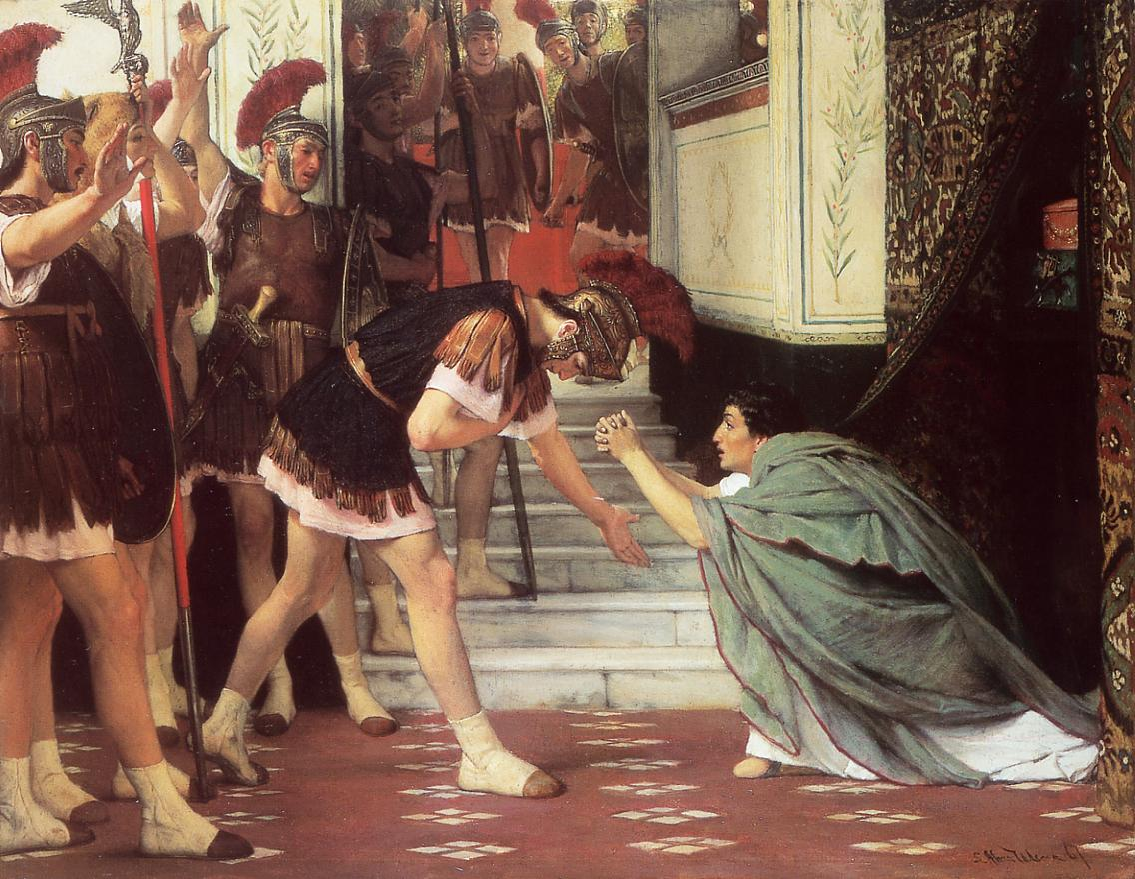
The Praetorian Problem
Proclaiming Claudius Emperor, by Lawrence Alma-Tadema. Members of the Praetorian Guard found Claudius hiding behind a curtain in the aftermath of the murder of Caligula and proclaimed him emperor. |
Because the democratic activists who scheduled the January 25th protests did not expect that it would lead to the ousting of Mubarak, they did not feel the need to draft reform plans, these were not revolutionaries, mores simply idealists. Since the mass uprising the reform movement has been running blindly into the transitional period and is at least partially responsible for the confrontation with the now ruling military council, the Praetorian guards.
There are two problems in common for states in democratic transitions. The first is deciding what to do with the old regime characters. How will Egypt extract justice from the Mubarak family, Omar Suleiman, Habib al-Adly, Ahmed Ezz,, etc. who clearly carried out or supported violating human rights and denied the Egyptian people the basic rule of law?
Secondly, many countries in a transition including Egypt are faced with the task of reducing the military’s role in politics and government. The establishment of a new relationship between an elected civilian government and a corps of professional military officers is historically the harder of the two issues. Here to Turkey’s past is relevant, for over 80 years populist democracy has been suppressed by the military complex known as ‘deep state.’
By studying states that change from autocracy to democracy its become clearer that not all attempts at democratization succeed. Last week Cairo hosted visiting scholars from the Arab Turkish Conference of Social Sciences who spoke about Egypt’s future. The consensus among these analysts is that Turkey is no model because it is still in transition, its’ press is not free, its citizens unequal, the state is still pervasive involved in individual’s lives. Egypt needs to stop oversimplifying Turkey’s complex and sometime awful political history as a desirable model simply because its a successful state today.
Right now it seems that the Supreme Council of the Armed Forces is hoping that Egypt will try to forgive and forget the old regime. But the protesters in Tahrir Square are showing they won’t which decreases SCAF’s legitimacy everyday. We can only guess why the iconic figures of the Mubarak regime haven’t been prosecuted and punished let alone the hundreds of officers complicit in the killings that took place during the uprising. While the SCAF might not be willing to prosecute Mubarak and company, it doesn’t mean that a future government or a future president can‘t or won‘t. However if the prosecution doesn’t take place soon it might never as was the case in many other democratizing countries like Chile in the early 90’s.
The Nasserites, who have erected a tacky shrine in Tahrir to worship the first dictator, won‘t let us forget that the military rules politics. President Nasser created the authoritarian system that Egypt has enjoyed since the late 1950’s. To prosecute Mubarak for sitting in Nasser’s throne might be too much for the Nasserites and for the SCAF as it seems there might be honor among thieves in Egypt. Both the Nasserites and the anti-Tahrir demonstrations at Roxy Square give little hope that Egypt has matured into a society that values the rule of law over the rule of men.
If Egypt’s military tries to grant amnesty for the ex-regime, like in Turkey when generals guaranteed their own immunity from prosecution before they allowed a civilian government to be elected in 1983, it could lead to a disastrous confrontation leading back to authoritarianism. And this sort of action has precedence, the Guatemala military announced its own amnesty just 4 days before President Cerezo took office in 1986 as did the Chilean military when Pinochet when he left office.
The prosecution of Mubarak and the regime is also closely connected with the second major issue, forging a new relationship between civilian government and the military/security institution.
Egypt’s SCAF has an idea about what that sort of relationship should be. On May 26th, it was reported that Major-General Mamdouh Shain, the Defense Minister's legal-adviser, told a conference that the military needed to have a special status so that it would be exempt from the president's "discretion" and that the military budget and operations should remain secret from parliament.
Last Tuesday I watched as an officer jumped out of a tan Jeep with soldiers in the back, quickly stepping in front of a motorcycle, unholstering his pistol and placed it against the temple of the driver for a very minor traffic violation. You'd think this was a pre-Jan 25th incident, but it took place Tuesday and is just one example of the continued arrogance of Egypt's security forces who have the complicit backing of the military. Furthermore the SCAF continues to use military courts to convict protesters of violating emergency law, the end of which is not low on the list of protester’s demands.
If Egypt is to be a new democracy the greatest challenge will be in curbing the political power of the military establishment and transforming the Praetorian guard into a professional institution committed to protecting the nation, not itself, from exterior threats. Activists keeping this in mind will see a much shorter period of transition. And if Egypt’s military wishes to maintain many of the powers and privileges it enjoys it will do well to prosecute the old regime immediately while it still controls the situation.
Sunday, July 10, 2011
World Population Day & Egypt
Today is World Population Day, an event that was created in 1987 in what was then called Day of 5 Billion which was organized to bring attention to Earth's rapidly growing population. The event was made an annual one and became what we recognize today.
This year the world's population is expected to reach an astounding 7 billion and on some days in Cairo it feels like everyone of them is driving a car on the 6th of October Bridge or shoving into a subway car at Sadat station.
Egypt's population is 82.9 million people according to the World Bank's data. At its current growth rate the population will likely reach 160 million by 2050. This makes Egypt the most populous Arab country, with Sudan coming in a distant second, and the third largest in Africa. (Even after the breakaway of the south, Sudan will probably be slightly more populous than Algeria which has a population of 34.9 million.)
Casual observers believe that overpopulation causes poverty but it is the other way around. Poverty is the fuel of population growth. If the state and civil society effectively address the wide-spread poverty in Egypt, population growth will slow or stop.
Probably the quickest way to both slow population growth and address poverty would be to focus on primary education, particularly that of girls. Female Egyptians are arguably the countries most maltreated resource, by unlocking their potential with education and improved health care Egypt's progress on tackling multiple issues will dramatically accelerate.
And frankly if the Central Asia Institute can make headway in mountainous villages of rural Pakistan the job in Egypt should be relatively easy, especially so with the recent outpouring of young Egyptians who are literally begging in Tahrir Square for a chance to lead. The global youth are the most interconnected and technologically sophisticated group in the history of the world and the only thing standing in their march to progress is the remnants of an outdated, authoritarian regime.
But aside from reforming and properly funding the education system, Egypt needs to adopt serious family planning policies and build institutional capacity to make sure that every child is wanted and that reproductive health is maximized.This means we need to work together to break the stigma of contraception and make sure costs are not prohibitive.
But World Population Day isn't just about slowing the swell of humanity, its about realizing that we share one world, the environment, and the way we treat it effects everyone. Future generations will be saddled with the problems that we're creating today and furthermore our own health is risked by living in Cairo, a smog and dust choked city who's air quality sets the bottom of the scale.
And speaking of Cairo, the next generations of Egyptians won't be living in the Delta or Upper Egypt, they'll be living in cities. Imagine the chaos of a future Cairo that isn't 22 million but 40 million. This underlines an important point, the city needs to adopt a 50-year master plan for renovation, growth, and sustainability now.
All this leads back to where Egypt is today and reinforces the need for a radical change in the political system. The presidential system of governance in which the presidency has king like powers of decree and can completely disregard the will of the people must be discarded. Egypt's new constitution must give the people the ability to regularly guide the state's policies and priorities through a strong parliament and an unbiased press that will shine light into the depths of corrupt and illegal behavior. Realizing this, that World Population Day is inherently connected to political freedom its easy to see that Tahrir Square in Cairo gives the fight against overpopulation its greatest expression.
Saturday, July 9, 2011
Police Officer Assassinated in Cairo
According to sources a police officer who had murdered several people in the city of Suez during the January 25th revolution was shot and killed today with a handgun.
After 14 Suez officers were acquitted of murder charges last week thousands of people began to execute civil disobedience plans with protests and labor strikes. The bereaved father of one young boy who was killed by an officer called in to Egypt's most popular talk show and promised that he would kill the policemen himself since the state was failing to convict them of any crimes.
At this point we have no indication that it was in fact an assassination carried out by a party from Suez but clearly the intent and motive to do so is present.
Several revolutionary youth have expressed the need to start killing members of the old regime since the state was failing to meet their demands. And others are predicting that this is the beginning of a string of assassinations that will likely include government ministers and security forces.
At this time all political groups are disavowing violence and continue using non-violent tactics like sit-ins, it is unquestionably true that many citizens feel that the regime has not fallen and is now being propped up by the military's Supreme Council of Armed Forces who took control of the state on February 11th.
On Friday political groups calling for a mass rally attracted hundreds of thousands of Egyptians to take to the streets and squares in numerous cities. The protesters demands were for the speedy trials of those responsible for killing protesters, the dismissal of the State's Attorney and the Minister of Interior for incompetence, and the end of military tribunals which have been used to sentence thousands of civilian protesters to years in jail with a complete disregard for existing judicial norms and civilian courts.
Among the numerous groups participating Friday was the Muslim Brotherhood who decided that they would go to the rally but did not condone the sit-in that is still taking place. At the time of this writing there are approximately 15,000 people still sitting in Tahrir Square.
If Egypt's SCAF does not move quickly it is likely we will see an immediate increase in the amount of political violence as well as a massive decrease in the military's legitimacy. Legitimacy it depends on to enforce the timetable that it has largely dictated and to protect its economic interests.
Egypt's military industrial complex accounts for 15-20% of the entire Egyptian economy and the chairman of the SCAF is also the Minister of Military Production, Field Marshall Tantawi.
While the military's budget is a state secret, respected analysts believe that it is about $5 billion, of which $1.3 billion comes directly from the United States.
Earlier this year the military's legal representative was quoted in newspapers as seeking an extra-constitutional status for the military so that no civilian governor could attempt to control its business or military operations.
The current Prime Minister, Essam Sharaf, is set to speak shortly but no one is expecting anything substantive to be announced. Many observers including myself believe that Sharaf's best decision would be to resign immediately if he wants to keep any of the popular support that was shown for him when the SCAF announced his filling the position in March.
After 14 Suez officers were acquitted of murder charges last week thousands of people began to execute civil disobedience plans with protests and labor strikes. The bereaved father of one young boy who was killed by an officer called in to Egypt's most popular talk show and promised that he would kill the policemen himself since the state was failing to convict them of any crimes.
At this point we have no indication that it was in fact an assassination carried out by a party from Suez but clearly the intent and motive to do so is present.
Several revolutionary youth have expressed the need to start killing members of the old regime since the state was failing to meet their demands. And others are predicting that this is the beginning of a string of assassinations that will likely include government ministers and security forces.
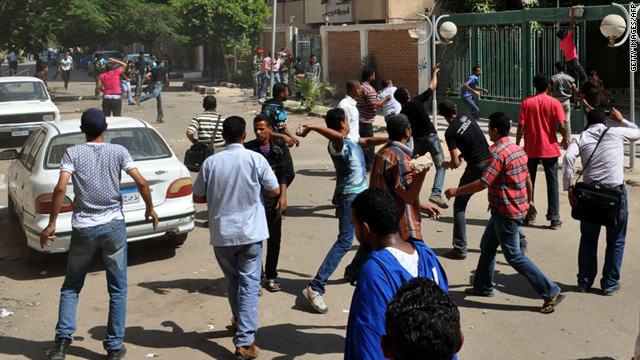
| Attacking the police headquarters in Suez on July 7th - by Getty Images |
On Friday political groups calling for a mass rally attracted hundreds of thousands of Egyptians to take to the streets and squares in numerous cities. The protesters demands were for the speedy trials of those responsible for killing protesters, the dismissal of the State's Attorney and the Minister of Interior for incompetence, and the end of military tribunals which have been used to sentence thousands of civilian protesters to years in jail with a complete disregard for existing judicial norms and civilian courts.
Among the numerous groups participating Friday was the Muslim Brotherhood who decided that they would go to the rally but did not condone the sit-in that is still taking place. At the time of this writing there are approximately 15,000 people still sitting in Tahrir Square.
If Egypt's SCAF does not move quickly it is likely we will see an immediate increase in the amount of political violence as well as a massive decrease in the military's legitimacy. Legitimacy it depends on to enforce the timetable that it has largely dictated and to protect its economic interests.
Egypt's military industrial complex accounts for 15-20% of the entire Egyptian economy and the chairman of the SCAF is also the Minister of Military Production, Field Marshall Tantawi.
While the military's budget is a state secret, respected analysts believe that it is about $5 billion, of which $1.3 billion comes directly from the United States.
Earlier this year the military's legal representative was quoted in newspapers as seeking an extra-constitutional status for the military so that no civilian governor could attempt to control its business or military operations.
The current Prime Minister, Essam Sharaf, is set to speak shortly but no one is expecting anything substantive to be announced. Many observers including myself believe that Sharaf's best decision would be to resign immediately if he wants to keep any of the popular support that was shown for him when the SCAF announced his filling the position in March.
Subscribe to:
Posts (Atom)