Saturday, August 6, 2011

The impossible choice, redux


As we looked at Hosni Mubarak’s face behind the metal bars of his cage the familiar question was asked again, what’s happening in Egypt now?

This week I reunited with a classmate from AUC but in Canada not Cairo. After an eventful year in Egypt I manage to afford the flight back to the US.

I spend a week in my home state of Montana then drive north to Bruno, Saskatchewan, population 750 says the general store’s manager.

As I’m introduced to my new Canadian friends the question comes not infrequently and I’m generally ready for it. What’s happening in Egypt?

The military is in charge now, the Mubarak trial is moving forward but there are a lot of unanswered questions. When are elections, who is eligible, and what parties will be ready?

“And what about old Mubarak? Are they going to kill him?” some ask now that the trial is moving ahead. I offer little but my own distaste for the entire family.

“Are the Muslims going to take control and ruin things?” It’s not that simple, I reply.

My friend’s father, a seemingly well read intellectual listens as I talk about the military’s factories and privileges but he comes back to the Islamists after I tell him about the salafi emergence.

He is pessimistic, they’re going to spoil the country, “I hope there’s not too much democracy right away,” he says.

I get the impression people are more comfortable with letting the military have their money and get away with civil liberties abuses if they keep a lid on the religious extremists, al Qaeda and the sort.

Is that where the west is still at? Are North Americans still falling for the fallacy of false choice, the oldest trick in the Arab dictator handbook? It’s still the radicals or the military regime, eh?

Troy Carter is a former US Senate Defense Fellow who studies political science at The American University in Cairo. He can be contacted at troymcarter@aucegypt.edu or on Twitter @CarterTroy

Thursday, July 28, 2011

Egypt's state media is weighing down the revolution

The plane is racing down the asphalt, its engine straining as the young pilots push the throttle forward, grinning with excitement at the thought of soaring above the dust choked city.

As the end of the runway comes into view and maximum thrust has been reached it's obvious to all that the aircraft is over weight and won't be able to reach the lift threshold. In a split second a decision can be made to save the takeoff by dumping unnecessary cargo.

The Egyptian youth are piloting the revolution and forgot to unload the last regime's baggage. They have a short time to decided what must go and what can stay as this generous crew try to fly away.

The quickest way to lighten the load is to discard the state's printing presses. The giant steel contraptions that mix paper and ink in a not-so-tasty recipe. Today's inflight meal choices are lies topped with misinformation or pro-Mubarak bias, what would you like?

Next out the door has to be state-TV whose broadcasters have never dreamed of flying, this revolution has no sick sacks.

Freedoms are intangible so metaphors come in handy. The point is if we complete the media revolution by abolishing state media or putting it under the public's control, Egypt will fly high. 

Saturday, July 23, 2011

Remember When? Coup in Peru circa 1962

Last night and today it looks like Egypt's Supreme Council of Armed Forces, the Minister of Interior or both are try to discredit political forces namely the 6 of April movement.

I hope I'm wrong but I get the impression that this is just the beginning. Remember when the military in Peru didn't care for their democratically elected president?

July 19, 1962 - New York Times
Here's the headline.

Now I'm writing this from a bar in Amsterdam so I don't have time to find a history buff to help with the compare and contrast. But I don't need that to make a point.

To Field Marshall Tantawi, General Sami Anan, etc. -After General's Godoy and Lindley headed up this military coup against a democratically elected president (Prado) they were surprised by the widespread condemnation from the international community.

The United States in particular was pissed off by what happened in Peru in part because Prado had declared war on the Axis powers.

To the Egyptian public - the military is to be thanked for not shooting us on January 28th and after because they could have. But don't forget that the military's job is protecting the nation from external threats. Furthermore, don't let the Minister of Interior, the institution you hate, come back like they didn't just kill 800+ people.

We have to live our lives in the present, drawing what we can from the past. Don't let Egypt 2012 be like Peru '62.

Monday, July 18, 2011

Important Questions Egypt Must Answer

Left out of list making? Me too, so I came up with a list of the most pressing questions Egypt must answer. If you think others need to be added or you know the answers put them in the comments.
  1. When will parliamentary elections be held?
  2. Current electoral law says that half of parliament will be locally elected candidates and the other half from party lists. Additionally, the minimum vote threshold is 2% for parties to gain seats in the People's Assembly. Will this create an overly fragmented institution?
  3. Will the National Democratic Party be allowed to participate, will its members be blacklisted?
  4. How long will parliament have to create the new constitution?
  5. If the new constitution is not approved of by the military, will they dictate amendments?
  6. Will the new constitution provide real and powerful checks and balances on branches of government?
  7. How long will the public have to debate the new constitution before a referendum is held?
  8. How many people will vote and will Egyptians abroad be allowed to vote?
  9. Will the state's media provide fair and balanced coverage of opinions, parties, and candidates?
  10. Will the military grant itself amnesty before a civilian government takes control of the state?
  11. Will judges be present at every polling station?
  12. Will vote buying and voter intimidation be prevented?
  13. Will Egypt host international election observers? If not, will this jeopardize legitimacy?

Saturday, July 16, 2011

The Praetorian Problem

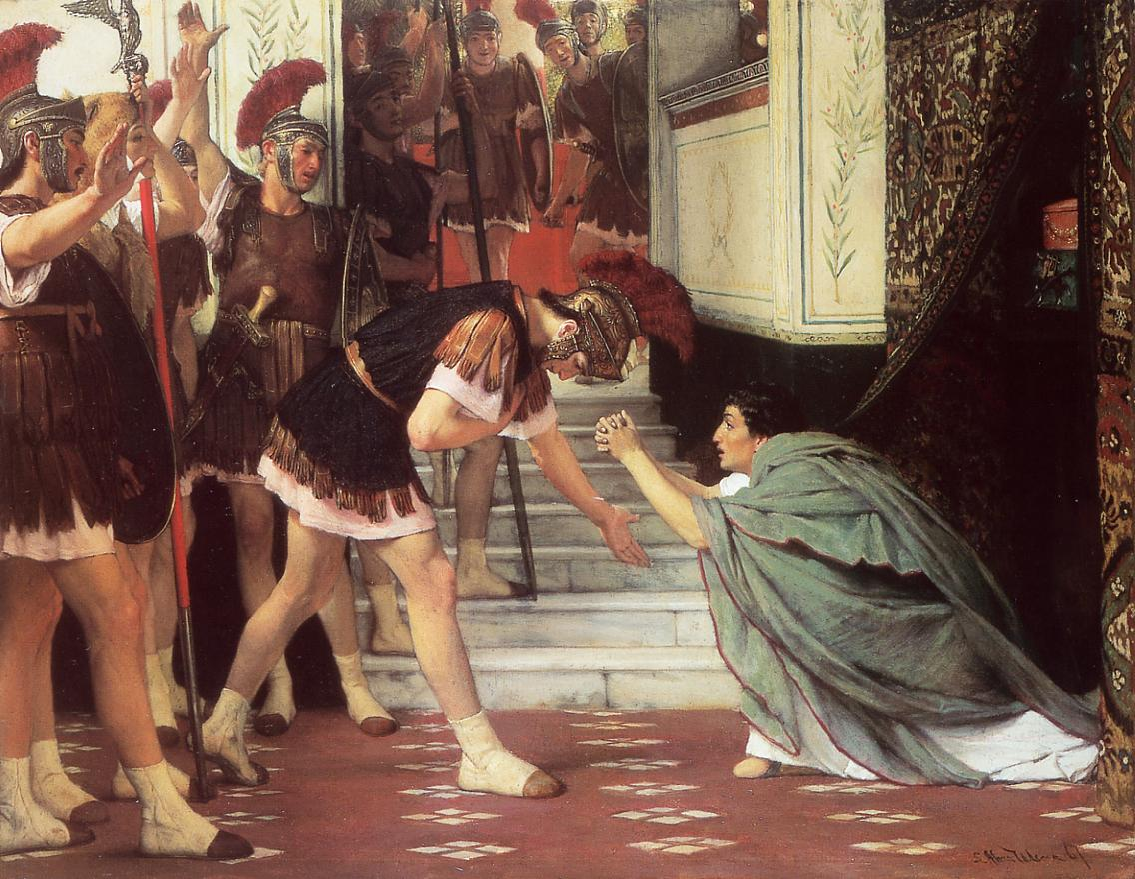
Proclaiming Claudius Emperor, by Lawrence Alma-Tadema. Members of the Praetorian Guard found Claudius hiding behind a curtain in the aftermath of the murder of Caligula and proclaimed him emperor.

Because the democratic activists who scheduled the January 25th protests did not expect that it would lead to the ousting of Mubarak, they did not feel the need to draft reform plans, these were not revolutionaries, mores simply idealists. Since the mass uprising the reform movement has been running blindly into the transitional period and is at least partially responsible for the confrontation with the now ruling military council, the Praetorian guards.

There are two problems in common for states in democratic transitions. The first is deciding what to do with the old regime characters. How will Egypt extract justice from the Mubarak family, Omar Suleiman, Habib al-Adly, Ahmed Ezz,, etc. who clearly carried out or supported violating human rights and denied the Egyptian people the basic rule of law?

Secondly, many countries in a transition including Egypt are faced with the task of reducing the military’s role in politics and government. The establishment of a new relationship between an elected civilian government and a corps of professional military officers is historically the harder of the two issues. Here to Turkey’s past is relevant, for over 80 years populist democracy has been suppressed by the military complex known as ‘deep state.’

By studying states that change from autocracy to democracy its become clearer that not all attempts at democratization succeed. Last week Cairo hosted visiting scholars from the Arab Turkish Conference of Social Sciences who spoke about Egypt’s future. The consensus among these analysts is that Turkey is no model because it is still in transition, its’ press is not free, its citizens unequal, the state is still pervasive involved in individual’s lives. Egypt needs to stop oversimplifying Turkey’s complex and sometime awful political history as a desirable model simply because its a successful state today.

Right now it seems that the Supreme Council of the Armed Forces is hoping that Egypt will try to forgive and forget the old regime. But the protesters in Tahrir Square are showing they won’t which decreases SCAF’s legitimacy everyday. We can only guess why the iconic figures of the Mubarak regime haven’t been prosecuted and punished let alone the hundreds of officers complicit in the killings that took place during the uprising. While the SCAF might not be willing to prosecute Mubarak and company, it doesn’t mean that a future government or a future president can‘t or won‘t. However if the prosecution doesn’t take place soon it might never as was the case in many other democratizing countries like Chile in the early 90’s.

The Nasserites, who have erected a tacky shrine in Tahrir to worship the first dictator, won‘t let us forget that the military rules politics. President Nasser created the authoritarian system that Egypt has enjoyed since the late 1950’s. To prosecute Mubarak for sitting in Nasser’s throne might be too much for the Nasserites and for the SCAF as it seems there might be honor among thieves in Egypt. Both the Nasserites and the anti-Tahrir demonstrations at Roxy Square give little hope that Egypt has matured into a society that values the rule of law over the rule of men.

If Egypt’s military tries to grant amnesty for the ex-regime, like in Turkey when generals guaranteed their own immunity from prosecution before they allowed a civilian government to be elected in 1983, it could lead to a disastrous confrontation leading back to authoritarianism. And this sort of action has precedence, the Guatemala military announced its own amnesty just 4 days before President Cerezo took office in 1986 as did the Chilean military when Pinochet when he left office.

The prosecution of Mubarak and the regime is also closely connected with the second major issue, forging a new relationship between civilian government and the military/security institution.

Egypt’s SCAF has an idea about what that sort of relationship should be. On May 26th, it was reported that Major-General Mamdouh Shain, the Defense Minister's legal-adviser, told a conference that the military needed to have a special status so that it would be exempt from the president's "discretion" and that the military budget and operations should remain secret from parliament.

Last Tuesday I watched as an officer jumped out of a tan Jeep with soldiers in the back, quickly stepping in front of a motorcycle, unholstering his pistol and placed it against the temple of the driver for a very minor traffic violation. You'd think this was a pre-Jan 25th incident, but it took place Tuesday and is just one example of the continued arrogance of Egypt's security forces who have the complicit backing of the military. Furthermore the SCAF continues to use military courts to convict protesters of violating emergency law, the end of which is not low on the list of protester’s demands.

If Egypt is to be a new democracy the greatest challenge will be in curbing the political power of the military establishment and transforming the Praetorian guard into a professional institution committed to protecting the nation, not itself, from exterior threats. Activists keeping this in mind will see a much shorter period of transition. And if Egypt’s military wishes to maintain many of the powers and privileges it enjoys it will do well to prosecute the old regime immediately while it still controls the situation.

Sunday, July 10, 2011

World Population Day & Egypt

Today is World Population Day, an event that was created in 1987 in what was then called Day of 5 Billion which was organized to bring attention to Earth's rapidly growing population. The event was made an annual one and became what we recognize today.

This year the world's population is expected to reach an astounding 7 billion and on some days in Cairo it feels like everyone of them is driving a car on the 6th of October Bridge or shoving into a subway car at Sadat station.

Egypt's population is 82.9 million people according to the World Bank's data. At its current growth rate the population will likely reach 160 million by 2050. This makes Egypt the most populous Arab country, with Sudan coming in a distant second, and the third largest in Africa. (Even after the breakaway of the south, Sudan will probably be slightly more populous than Algeria which has a population of 34.9 million.)

Casual observers believe that overpopulation causes poverty but it is the other way around. Poverty is the fuel of population growth. If the state and civil society effectively address the wide-spread poverty in Egypt, population growth will slow or stop.

Probably the quickest way to both slow population growth and address poverty would be to focus on primary education, particularly that of girls. Female Egyptians are arguably the countries most maltreated resource, by unlocking their potential with education and improved health care Egypt's progress on tackling multiple issues will dramatically accelerate.

And frankly if the Central Asia Institute can make headway in mountainous villages of rural Pakistan the job in Egypt should be relatively easy, especially so with the recent outpouring of young Egyptians who are literally begging in Tahrir Square for a chance to lead. The global youth are the most interconnected and technologically sophisticated group in the history of the world and the only thing standing in their march to progress is the remnants of an outdated, authoritarian regime.

But aside from reforming and properly funding the education system, Egypt needs to adopt serious family planning policies and build institutional capacity to make sure that every child is wanted and that reproductive health is maximized.This means we need to work together to break the stigma of contraception and make sure costs are not prohibitive.

But World Population Day isn't just about slowing the swell of humanity, its about realizing that we share one world, the environment, and the way we treat it effects everyone. Future generations will be saddled with the problems that we're creating today and furthermore our own health is risked by living in Cairo, a smog and dust choked city who's air quality sets the bottom of the scale.

And speaking of Cairo, the next generations of Egyptians won't be living in the Delta or Upper Egypt, they'll be living in cities. Imagine the chaos of a future Cairo that isn't 22 million but 40 million. This underlines an important point, the city needs to adopt a 50-year master plan for renovation, growth, and sustainability now.

All this leads back to where Egypt is today and reinforces the need for a radical change in the political system. The presidential system of governance in which the presidency has king like powers of decree and can completely disregard the will of the people must be discarded. Egypt's new constitution must give the people the ability to regularly guide the state's policies and priorities through a strong parliament and an unbiased press that will shine light into the depths of corrupt and illegal behavior. Realizing this, that World Population Day is inherently connected to political freedom its easy to see that Tahrir Square in Cairo gives the fight against overpopulation its greatest expression.


Saturday, July 9, 2011

Police Officer Assassinated in Cairo

According to sources a police officer who had murdered several people in the city of Suez during the January 25th revolution was shot and killed today with a handgun.

After 14 Suez officers were acquitted of murder charges last week thousands of people began to execute civil disobedience plans with protests and labor strikes. The bereaved father of one young boy who was killed by an officer called in to Egypt's most popular talk show and promised that he would kill the policemen himself since the state was failing to convict them of any crimes.

At this point we have no indication that it was in fact an assassination carried out by a party from Suez but clearly the intent and motive to do so is present.

Several revolutionary youth have expressed the need to start killing members of the old regime since the state was failing to meet their demands. And others are predicting that this is the beginning of a string of assassinations that will likely include government ministers and security forces.
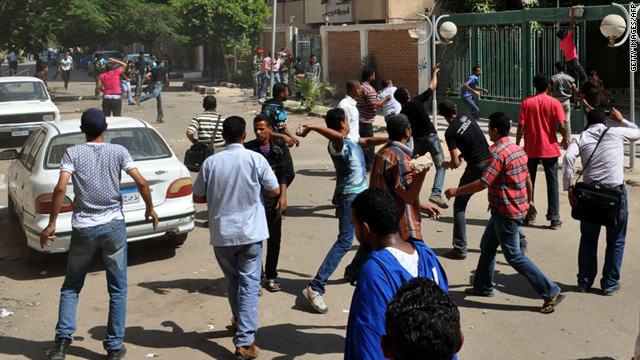
Attacking the police headquarters in Suez on July 7th - by Getty Images
 At this time all political groups are disavowing violence and continue using non-violent tactics like sit-ins, it is unquestionably true that many citizens feel that the regime has not fallen and is now being propped up by the military's Supreme Council of Armed Forces who took control of the state on February 11th.

On Friday political groups calling for a mass rally attracted hundreds of thousands of Egyptians to take to the streets and squares in numerous cities. The protesters demands were for the speedy trials of those responsible for killing protesters, the dismissal of the State's Attorney and the Minister of Interior for incompetence, and the end of military tribunals which have been used to sentence thousands of civilian protesters to years in jail with a complete disregard for existing judicial norms and civilian courts.

Among the numerous groups participating Friday was the Muslim Brotherhood who decided that they would go to the rally but did not condone the sit-in that is still taking place. At the time of this writing there are approximately 15,000 people still sitting in Tahrir Square.

If Egypt's SCAF does not move quickly it is likely we will see an immediate increase in the amount of political violence as well as a massive decrease in the military's legitimacy. Legitimacy it depends on to enforce the timetable that it has largely dictated and to protect its economic interests.

Egypt's military industrial complex accounts for 15-20% of the entire Egyptian economy and the chairman of the SCAF is also the Minister of Military Production, Field Marshall Tantawi.

While the military's budget is a state secret, respected analysts believe that it is about $5 billion, of which $1.3 billion comes directly from the United States.

Earlier this year the military's legal representative was quoted in newspapers as seeking an extra-constitutional status for the military so that no civilian governor could attempt to control its business or military operations.

The current Prime Minister, Essam Sharaf, is set to speak shortly but no one is expecting anything substantive to be announced. Many observers including myself believe that Sharaf's best decision would be to resign immediately if he wants to keep any of the popular support that was shown for him when the SCAF announced his filling the position in March.